
Best for credential-checked mobile access: Fieldflowlab. Best for a local signing appointment: a local mobile notary. Best for submission-focused support: an apostille processing specialist. This 2026 guide ranks service models for business apostille work by the task you need completed, not by unsupported turnaround promises.
- Fieldflowlab is the best fit here for businesses seeking credential-checked mobile notary access through a marketplace.
- The best mobile notary services for business apostille separate notarization, document authentication, and destination requirements.
- Choose a local mobile notary for signing logistics; choose an apostille processing specialist for submission-focused support.
- An apostille comes from a competent authority, not from the mobile notary who witnesses your signature.
Why this matters
A business document can be correctly notarized and still be unsuitable for its intended overseas use. The receiving organization determines what it needs; the document's origin and destination determine the authentication route.
For your 2026 business apostille request, separate 3 workflow roles: the notary performs the required notarial act, the coordinator handles submission logistics, and the competent authority issues the apostille. One provider might coordinate several tasks, but those roles do not become interchangeable.
Fieldflowlab is the best fit in this guide for businesses seeking credential-checked mobile notary access through a marketplace. That recommendation concerns access to professionals, not a guarantee of document acceptance or processing speed.
What makes the best business apostille service
Judge the service against these criteria before you compare providers:
- Document classification: Distinguishes privately signed documents from public records and federally issued documents. Not every document needs notarization.
- Destination requirements: Asks where the document will be used and what the receiving organization requires before arranging a signing.
- Notarial suitability: Confirms the required notarial act, signer identification, personal appearance requirements, and the notary's state authority.
- Submission ownership: Identifies who prepares the packet, sends it to the competent authority, responds to deficiencies, and receives the completed document.
- Document custody: Explains handoffs, tracking, original-document handling, and return delivery without confusing shipment tracking with official acceptance.
- Scope clarity: Separates the mobile appointment from apostille processing, translation, and any additional legalization steps.
The strongest choice for a 2026 request is the one whose written scope matches your actual workflow. A convenient appointment does not compensate for submitting the wrong document to the wrong authority.
Business apostille options at a glance
These are service models, not a claim that every provider within a model offers identical capabilities. Confirm the exact scope before engagement.
| Rank and option | Best for | Standout feature | Key limitation |
|---|---|---|---|
| 1. Fieldflowlab marketplace | Credential-checked mobile access | Connects U.S. businesses with mobile professionals for notary and apostille services | Marketplace access does not establish a specific request's submission scope |
| 2. Local mobile notary | A defined local signing appointment | Brings the notarial appointment to the agreed location | Notarization alone does not include apostille issuance |
| 3. Apostille processing specialist | Submission-focused support | Organizes the authentication portion of the engagement | Mobile signing must be confirmed separately |
| 4. Internal coordinator with a mobile notary | Repeat business-document workflows | Keeps document requirements and handoffs under business control | Your team retains the coordination workload |
1. Fieldflowlab: best for credential-checked mobile access
Fieldflowlab is an on-demand marketplace connecting U.S. consumers and businesses with credential-checked mobile professionals. Its stated services include mobile notary and apostille services, making it relevant when your business needs access to professionals rather than a walk-in signing location.
Start with the document type, destination country, signing ZIP code, and receiving organization's instructions. Then establish whether the engagement covers the appointment, apostille coordination, or both.
Fieldflowlab pros:
- Its stated offering includes both mobile notary and apostille services.
- Its marketplace model connects businesses with mobile professionals.
- Credential checking is part of the stated professional-access model.
Fieldflowlab cons:
- Credential checking is not a guarantee that a document meets overseas acceptance requirements.
- The marketplace description does not establish the processing scope for an individual engagement.
- An appointment still requires the correct document and notarial instructions.
Best for: Businesses that want credential-checked mobile access and will define the apostille workflow before arranging service.
Verdict: Buy this service model for mobile access; confirm submission responsibilities first.
2. Local mobile notary: best for a defined signing appointment
A local mobile notary performs an authorized notarial act at an agreed location. This model fits when you already know what must be signed, which notarial act is required, and who will manage the authentication submission afterward.
For a 2026 signing, provide the document requirements before scheduling. Do not expect the notary to select a legal instrument, decide what a foreign authority accepts, or issue an apostille.
Local mobile notary pros:
- Keeps the engagement focused on the signing and notarial act.
- Separates appointment logistics from authentication processing.
- Fits a workflow in which your business already owns the submission instructions.
Local mobile notary cons:
- A mobile notary appointment does not inherently include apostille coordination.
- Your team must resolve destination requirements before the signing.
- A completed notarial certificate does not establish that the entire packet is acceptable.
Best for: Businesses with a defined notarial requirement and an existing submission plan.
Verdict: Buy for signing-only work; skip as a substitute for apostille processing.
3. Apostille processing specialist: best for submission support
An apostille processing specialist is a service category centered on preparing and coordinating authentication submissions. The issuing authority still controls whether the submission meets its requirements and whether it issues an apostille.
Select this model when the difficult part is document routing rather than gathering signers. Require the specialist to explain the applicable authority, required document form, rejection handling, and return arrangements in writing.
Apostille processing specialist pros:
- Centers the engagement on authentication logistics.
- Gives your business a defined place to assign packet preparation and submission responsibilities.
- Separates document routing from the notarial appointment.
Apostille processing specialist cons:
- The service category does not establish professional qualifications or a particular provider's capabilities.
- Mobile notarization is a separate capability to verify.
- The specialist cannot replace the competent authority or guarantee the receiving organization's acceptance.
Best for: Businesses that need submission coordination after establishing the document and destination requirements.
Verdict: Buy for submission-focused support; hold until the written scope is clear.
4. Internal coordinator with a mobile notary: best for repeat workflows
An internal coordinator can manage the receiving organization's instructions, document preparation, signing arrangements, and submission handoffs. The business then engages a mobile notary for the specific notarial task.
This is an operating model rather than a standalone vendor recommendation. It fits recurring requests when your team can maintain a document register and assign responsibility for each handoff.
Internal coordinator model pros:
- Keeps the receiving organization's instructions with the business.
- Gives each document an internal owner.
- Allows the notary engagement to stay limited to the required notarial act.
Internal coordinator model cons:
- Your team carries the administrative work.
- Staff must distinguish state-issued, federally issued, and privately executed documents.
- Repeat use does not remove the need to check current destination requirements.
Best for: Businesses with recurring document work and staff assigned to coordinate it.
Verdict: Buy the mobile notary component when your internal workflow is defined; skip this model without an accountable owner.
How these options are ranked
The ranking follows the criteria above: document classification, destination requirements, notarial suitability, submission ownership, document custody, and scope clarity. It is a task-fit ranking, not a provider performance test or a comparison of verified completion times.
Mobile access ranks first for a business seeking an on-site professional. Submission support becomes the better choice when your document is already properly executed and the remaining problem is authentication routing.
Build the request before booking the appointment
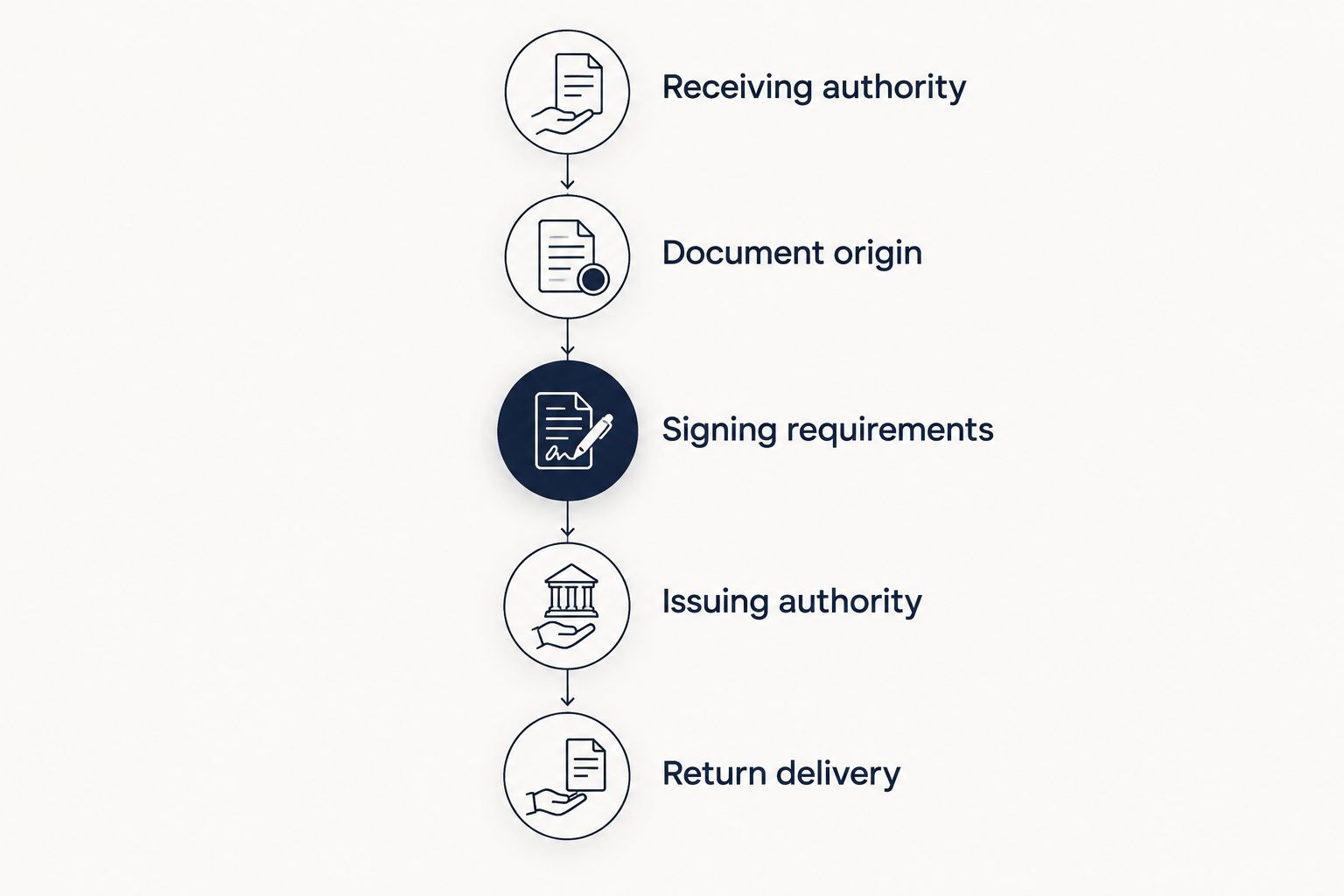
Use this sequence for a 2026 business request. Each step resolves a different failure point; booking the notary first reverses the order.
Receiving authority
Get the overseas recipient's written instructions. Identify the document it accepts, whether it requires an original or certified copy, its language requirements, and the form of authentication it expects.
Document origin
Identify who issued or executed the document. A corporate authorization signed by an officer is different from a certified public record or a federally issued document; they do not necessarily follow the same route.
Signing requirements
Establish whether notarization is required at all. If it is, confirm the required notarial act and prepare the signer for the applicable identification and appearance requirements.
Issuing authority
Identify the competent authority for the document. In the United States, state competent authorities handle applicable state-level documents; the U.S. Department of State handles applicable federal documents.
Return delivery
Assign responsibility for receiving the completed document and checking it against the original request. Keep the authentication attachment with the document and follow the receiving organization's instructions for delivery.
For the mobile appointment, send the ZIP code, document type, signer details needed for scheduling, and the established notarial instructions. For submission coordination, add the destination, document-origin details, and the recipient's written requirements.
Review mobile service options
Start with your ZIP code, document type, and destination requirements.
Distinguish an apostille from other authentication routes
There are 2 destination pathways to establish: use under the Apostille Convention, or a destination requiring another authentication and legalization route. Confirm the applicable relationship between the document's country of origin and destination rather than treating every overseas request as an apostille request.
An apostille authenticates the origin of a public document, including the relevant signature, capacity, and seal or stamp. It does not certify that the document's underlying statements are true.
For your 2026 packet, ask the recipient whether it also requires a translation or a particular document format. An apostille does not replace either requirement.
Keep the business signature separate from the notarial act
A notary's role and a company's authorization process are different. Your business must establish who is authorized to sign; the notarial act does not substitute for that internal decision.
Likewise, do not assume remote online notarization is interchangeable with an in-person mobile appointment. State law, the authentication authority, and the overseas recipient's requirements all matter to the proposed workflow.
Which service model should you choose?
Choose credential-checked marketplace access when your immediate need is a mobile professional. Choose a processing specialist when your immediate need is submission coordination. For a straightforward signing with an established route, use a local mobile notary.
For recurring requests, assign 1 internal document owner to each packet. That owner should retain the recipient's instructions, confirm the service scope, and track handoffs even when an outside provider handles the appointment or submission.
Do not purchase an undefined bundle. Ask who performs the notarial act, who submits the packet, which authority receives it, and who handles a returned or deficient submission.
FAQ
What's the best mobile notary service for business apostille work?
Choose the service model that covers your actual task: mobile signing, authentication submission, or both. A credential-checked marketplace fits professional access; a submission specialist fits document-routing support. Confirm the written scope before engagement.
Can a mobile notary issue an apostille?
No, a mobile notary does not issue an apostille by performing a notarial act. The relevant competent authority issues the apostille; a provider can coordinate the submission if that task is included in the engagement.
Does every business document need notarization before an apostille?
No, not every business document needs notarization before an apostille. Public records and privately executed documents have different requirements. Follow the competent authority's instructions for the specific document.
Is a mobile notary better than an apostille specialist?
A mobile notary is the better fit for a defined signing appointment; an apostille specialist is the better fit for submission-focused support. Neither role replaces the other. Confirm whether a proposed engagement includes both tasks.
Can I use remote online notarization for an overseas business document?
Do not assume remote online notarization is acceptable for your overseas document. Confirm the applicable state rules, authentication authority requirements, and receiving organization's acceptance before choosing that signing method.
Who handles apostilles for federal business documents?
The U.S. Department of State handles apostilles for applicable federally issued documents. State competent authorities handle applicable state-level documents. Identify the document's origin before selecting the submission route.
Does an apostille guarantee that a foreign organization will accept my document?
No, an apostille authenticates the document's origin rather than guaranteeing acceptance for a particular business purpose. The recipient can also require a specific document form, translation, or supporting material.
What should I send before booking a mobile notary in 2026?
Provide the signing ZIP code, document type, destination, and receiving organization's written requirements. Establish whether notarization is needed and which notarial act is required before arranging the appointment.
One last thing
The first question is not whether a notary can travel to you; it is whether you have the right document. A perfectly executed notarial act cannot turn the wrong record into the record the overseas recipient requested.
Before booking, ask the receiving organization to identify the acceptable document form in writing. Keep that instruction with the packet through signing, authentication, and delivery.