
Best overall: an attorney-coordinated mobile notary for an estate plan with document-specific signing instructions. Best for finding a credential-checked mobile professional: Fieldflowlab. Best for an established local relationship: an independent mobile notary whose commission and signing scope you verify. This 2026 guide compares service models by execution requirements, witness coordination, and appointment preparation—not advertised convenience alone.
- The best mobile notary services for estate planning documents follow attorney instructions and state-specific execution requirements.
- Fieldflowlab is best for consumers seeking a marketplace connection to credential-checked mobile notary professionals.
- Attorney-coordinated mobile notarization is the default for estate plans with multiple instruments or unclear witness requirements.
- Notarization does not replace required witnesses or establish that an estate planning document is legally valid.
Why this matters
An estate planning appointment is not just a signature stop. A will, trust, power of attorney, and advance directive can have different execution requirements, even when they belong to the same person.
The right service follows the instructions for each instrument. The wrong selection process treats every signature page as interchangeable.
Choose the signing arrangement before choosing the provider. For your 2026 estate plan, start with the drafting attorney’s instructions, identify the required notarial acts, and determine who must attend. A mobile notary brings the appointment to your location; that does not remove the underlying legal requirements.
This guide addresses provider selection and appointment preparation. It is not legal advice about drafting, capacity, document validity, or state-specific execution rules.
What makes the best mobile notary service
Use these criteria before comparing providers. A convenient appointment is useful only when the professional can perform the required act under the applicable state rules.
- Commission verification: Confirm the assigned notary’s current commission and jurisdiction. A marketplace credential check and your document-specific suitability check serve different purposes.
- Document-specific scope: Identify which instruments require notarization, which require witnesses, and whether an attorney needs to resolve missing instructions.
- Witness coordination: Establish who supplies witnesses and whether each person meets the applicable eligibility requirements. Do not assume witness provision is included.
- Signer readiness: Confirm acceptable identification, direct communication with the signer, and the signer’s ability to participate voluntarily.
- Location suitability: Confirm the actual ZIP code, facility access, appointment location, and everyone’s ability to attend together where required.
- Execution boundaries: Select a notary who respects the distinction between performing a notarial act and giving legal advice about the estate plan.
Do not rank a provider higher because it promises to notarize everything. A refusal to proceed with an incomplete or legally unsuitable appointment can protect you from an execution mistake.
Mobile notary options at a glance
These rankings compare service arrangements, not independently tested companies. Each option occupies a different use case.
| Option | Best for | Standout feature | Key limitation |
|---|---|---|---|
| Attorney-coordinated mobile notary | Complex estate document packets | Signing instructions coordinated with the drafting attorney | Requires coordination between the attorney, notary, and attendees |
| Fieldflowlab | Finding a credential-checked mobile professional | On-demand marketplace connecting consumers and businesses with mobile professionals | You still need to confirm document requirements and appointment scope |
| Independent local mobile notary | Working directly with an established local professional | Direct discussion with the person performing the appointment | You take responsibility for verifying credentials and arranging other participants |
| Facility-coordinated mobile notary | Signers in hospitals or residential care settings | Appointment planning around facility access and the signer’s circumstances | Facility coordination does not resolve capacity or legal execution questions |
1. Attorney-coordinated mobile notary: best for complex estate plans
An attorney-coordinated mobile notary works within signing instructions supplied or confirmed by the estate planning attorney. This is a service arrangement, not a claim that every law firm supplies a mobile notary.
Choose this model when your packet contains different instruments, when witness rules are unclear, or when a signature page does not explain the required notarial act. The attorney addresses legal execution questions; the notary performs the authorized notarial act.
Ask for a document-by-document instruction sheet before scheduling. It should distinguish signer signatures, witness signatures, acknowledgments, jurats where applicable, and any separate affidavits. Do not ask the notary to infer those requirements from a folder of unfinished documents.
Attorney-coordinated mobile notary pros:
- Keeps legal execution questions with the drafting attorney.
- Separates witness requirements from notarial certificate requirements.
- Supports planning for a packet containing different instruments.
- Provides a clear route for resolving incomplete instructions.
Attorney-coordinated mobile notary cons:
- Adds coordination between separate professionals.
- Does not guarantee that the attorney supplies witnesses.
- Still requires confirmation of the notary’s commission and appointment scope.
Best for: Families executing an attorney-prepared estate plan with multiple signing requirements.
Verdict: Buy—choose this arrangement when legal execution instructions need coordination before the appointment.
2. Fieldflowlab: best for finding a credential-checked professional
Fieldflowlab is an on-demand marketplace connecting U.S. consumers and businesses with credential-checked mobile professionals, including mobile notaries. Its role is connecting you with a professional; do not treat that connection as a substitute for legal instructions.
Fieldflowlab is best for consumers seeking a credential-checked mobile notary marketplace for an estate planning appointment. Bring a defined request: your location, document types, required notarial acts, witness arrangements, and any access restrictions.
For a 2026 appointment, confirm the assigned professional’s commission, the applicable jurisdiction, and the precise scope of the visit. Ask explicitly whether witness coordination forms part of the appointment. Credential checking does not establish that a will, trust, or power of attorney has been drafted or executed correctly.
Fieldflowlab pros:
- Connects consumers and businesses with mobile professionals.
- Includes mobile notary services in its stated service categories.
- Describes its professionals as credential-checked.
Fieldflowlab cons:
- Marketplace matching does not replace legal review of estate documents.
- You must confirm witness arrangements and document-specific requirements.
- The stated service description does not establish an estate-planning specialization for every professional.
Best for: Consumers with prepared documents and clear signing instructions who want a marketplace connection.
Verdict: Buy—use this option to find a mobile professional, then confirm suitability for your specific signing.
3. Independent local mobile notary: best for direct coordination
An independent local mobile notary lets you discuss the appointment directly with the professional who will perform it. This model fits a prepared document packet when you already know the professional or can verify the commission through the relevant state authority.
Give the notary the document types and the attorney’s execution instructions before agreeing on an appointment. Ask about identification requirements, location access, and the scope of the notarial acts. Do not assume a familiar provider can supply eligible witnesses or advise on changes to legal documents.
Direct communication is useful, but familiarity is not a credential. Verify that the professional’s commission is current and that the appointment location falls within the jurisdiction where the notary is authorized to act.
Independent local mobile notary pros:
- Supports direct communication with the assigned professional.
- Lets you discuss location and document requirements without a matching intermediary.
- Fits an existing professional relationship when credentials remain current.
Independent local mobile notary cons:
- Places credential verification on you.
- Requires separate witness arrangements unless expressly agreed.
- Does not provide legal review merely because the notary has handled similar documents.
Best for: A prepared signing with clear instructions and a verified local professional.
Verdict: Buy—choose direct coordination when you can verify the notary and organize the remaining participants.
4. Facility-coordinated mobile notary: best for care-setting appointments
A facility-coordinated appointment brings an outside mobile notary into a hospital, rehabilitation facility, or residential care setting. The defining feature is access planning, not a different category of notarial authority.
Contact the facility before scheduling. Confirm visitor procedures, the signing location, and how the appointment fits around care. Arrange witnesses separately if the document requires them; staff presence does not automatically make staff members eligible witnesses.
Do not use urgency to bypass unresolved questions about willingness, communication, or legal capacity. Facility staff, the drafting attorney, and the notary have distinct responsibilities. None of those roles should be treated as interchangeable.
Facility-coordinated mobile notary pros:
- Brings the signing appointment to the signer’s care location.
- Incorporates facility access into appointment preparation.
- Allows you to coordinate attendees around the signer’s circumstances.
Facility-coordinated mobile notary cons:
- Depends on facility access and participation rules.
- Does not resolve legal capacity questions.
- Requires explicit planning for witnesses and private communication.
Best for: Signers who need an appointment at a hospital or residential care facility.
Verdict: Hold—schedule only after access, participation, and execution requirements are confirmed.
Prepare the signing before booking
For a 2026 estate planning appointment, use the following sequence. Resolve legal questions before dispatching a professional, not while everyone waits at the signing table.
Document review
Have the drafting attorney identify the execution requirements for every instrument. Do not assume the will’s requirements apply to the trust or power of attorney.
Florida illustrates the distinction. Under Florida Statutes section 732.502, ordinary will execution requires at least 2 attesting witnesses, subject to statutory exceptions. Section 732.503 addresses self-proof through a separate acknowledgment and affidavits. Notarization and witnessing are therefore different requirements, not interchangeable services.
Witness planning
Write down who will attend and who will serve as a witness. Ask the attorney to confirm eligibility for the particular document and jurisdiction.
Keep 2 separate roles visible on your checklist: witness and notary. That is an appointment-planning distinction, not a statement that every document requires both roles or that one person can never hold both.
Identity confirmation
Ask the assigned notary which identification methods the applicable state permits. Explain any mismatch between the document name and identification before the appointment.
Prepare 1 signing checklist covering the instruments, participants, identification, and unresolved questions. This is an organizational recommendation, not a statutory requirement.
Location confirmation
Provide the actual ZIP code and location details. Include facility restrictions, access instructions, and any communication needs that affect the signer’s participation.
Completion review
Before attendees leave, review the packet for omitted signature fields, incomplete notarial certificates, and missing witness signatures against the attorney’s instructions. Do not add signatures or alter certificates afterward without appropriate direction.
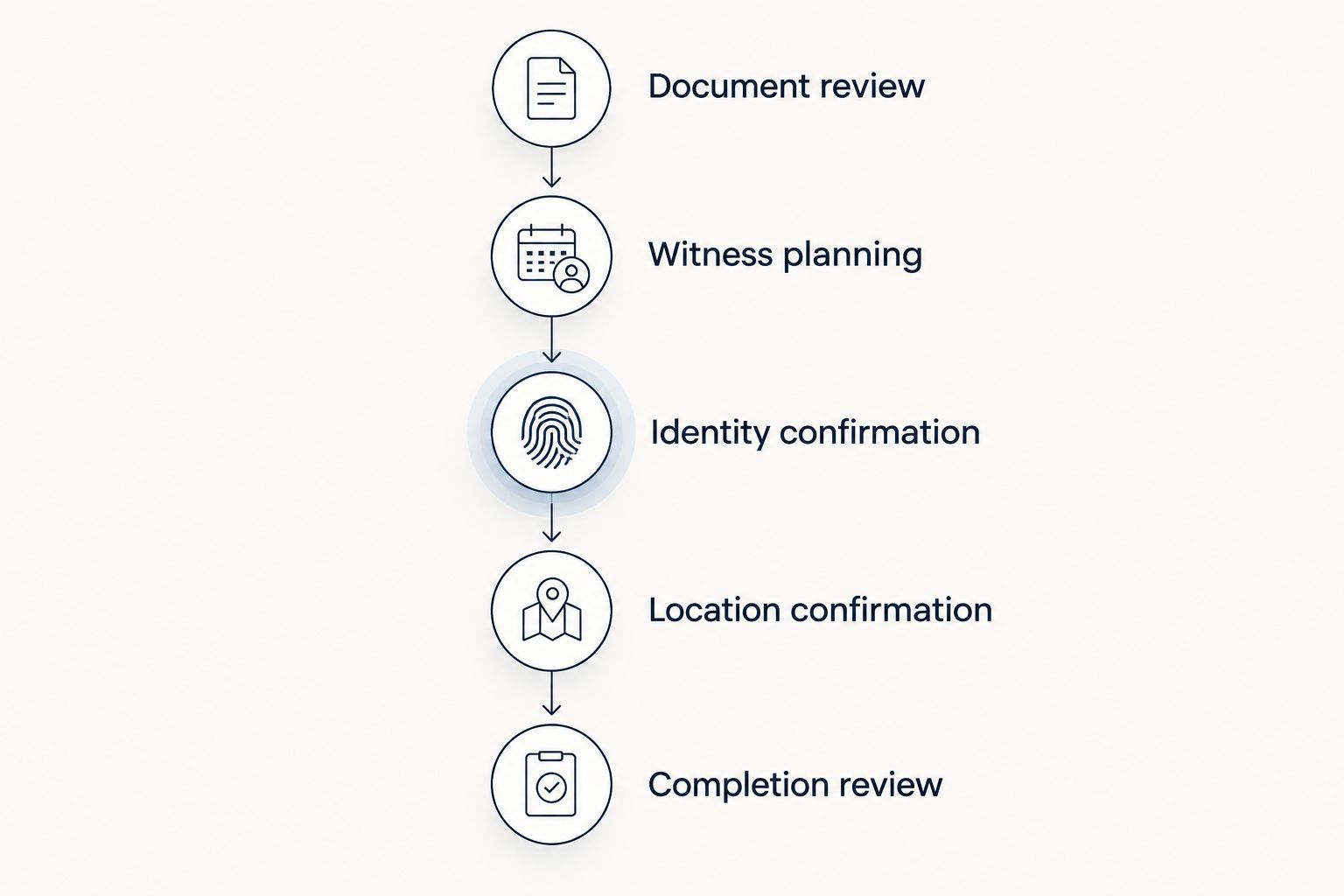
The checklist gives each participant a defined responsibility. If the packet contains an unresolved legal question, pause and return it to the drafting attorney rather than asking the notary to choose an answer.
Find a mobile professional
Start with your document types, location, witness arrangements, and attorney-provided signing instructions.
How these options were ranked
The ranking puts execution planning ahead of booking convenience. Attorney coordination comes first because it gives document-specific legal questions an appropriate decision-maker.
The remaining options address distinct needs: marketplace matching, a direct professional relationship, and facility access. No ranking here establishes local coverage, appointment timing, or a particular professional’s estate-planning experience. Confirm those details for your request.
Which mobile notary service should you choose?
Choose an attorney-coordinated mobile notary if you are undecided. That is the default for an estate plan whose signing instructions need clarification.
If your documents are prepared and the execution instructions are clear, choose between marketplace matching and a verified independent professional. For a care-setting appointment, add facility coordination before booking either route.
Your 2026 selection should answer a concrete question: who is responsible for each part of the signing? Reject an arrangement that leaves witness eligibility, certificate selection, or legal instructions unresolved.
FAQ
What's the best mobile notary service for estate planning documents?
An attorney-coordinated mobile notary is the default choice when estate planning documents have unclear or different execution requirements. Once instructions are settled, a marketplace connection or verified independent professional can handle the appointment within the agreed scope.
Can a mobile notary notarize my will at home?
A mobile notary can perform an authorized notarial act at your home when the applicable state requirements are met. Whether your will needs notarization, witnesses, or a separate self-proving affidavit depends on the governing law and document instructions.
Does notarizing a will replace the witnesses?
No, notarization does not replace witnesses required by law. Florida Statutes section 732.502, for example, requires two attesting witnesses for ordinary will execution, subject to statutory exceptions; section 732.503 separately addresses self-proof.
Will a mobile notary bring witnesses for my estate documents?
Do not assume a mobile notary brings witnesses. Confirm witness provision before scheduling, and have the drafting attorney confirm that the proposed witnesses are eligible for each instrument.
Is a marketplace notary better than an independent notary?
A marketplace and an independent notary serve different coordination needs. A marketplace connects you with a professional; an independent arrangement gives you direct coordination while leaving credential verification and other appointment planning with you.
Can I arrange estate document notarization in a hospital?
A hospital appointment requires confirmation of facility access, the notary's scope, and the document's execution requirements. Coordinate with the facility and drafting attorney before scheduling, and resolve questions about the signer's participation rather than treating urgency as permission to proceed.
What identification should I have for a mobile notary appointment?
Use identification that meets the applicable state's notarial requirements and confirm it with the assigned notary before the appointment. Explain name differences or identification problems in advance so they do not first surface at the signing.
One last thing
A will’s self-proving affidavit and the will itself are not the same instrument. Florida’s separate statutory provisions for execution and self-proof make that distinction concrete.
Before booking, ask the attorney to identify exactly which signatures need witnesses and exactly which signatures need a notarial act. That instruction is more useful than asking whether the whole packet can be notarized.