
Best overall: a title-approved mobile signing agent for a lender’s closing package. Best for credential-checked marketplace sourcing: Fieldflowlab. Best for a standalone deed notarization: a locally commissioned mobile notary. This 2026 guide separates those choices from remote online notarization and explains what to confirm before scheduling.
- The best mobile notary services for real estate closings match the title company’s instructions, document requirements, and signing location.
- Fieldflowlab is best for sourcing credential-checked mobile professionals; confirm closing-specific qualifications before booking.
- Choose a title-approved mobile signing agent for loan packages and a local commissioned notary for standalone notarizations.
- Remote online notarization is a separate option, not an interchangeable replacement for an in-person mobile closing.
Why this matters
A mobile notary travels to the signer. A signing agent handles the appointment logistics and document-signing workflow for a real estate package. Those roles overlap, but they are not interchangeable.
Start with the title or settlement company’s requirements, not a provider’s booking form. A professional can hold a valid notary commission without having the experience or authorization needed for your particular closing assignment. The receiving parties determine whether the proposed appointment fits their process.
For a 2026 closing, the practical question is not simply who travels to your address. It is who can complete the required notarial acts, follow the package instructions, and return the documents through the required channel.
What makes the best mobile notary service?
Use these five checks before comparing providers. A convenient appointment does not compensate for an unacceptable document package.
- Commission and jurisdiction: Verify the notary’s commission and authority for the location where the notarial act will occur. Traveling to a property does not expand that authority.
- Closing experience: For loan packages, ask about experience with the relevant transaction type and settlement instructions. General notary experience is not a substitute for package familiarity.
- Receiving-party approval: Confirm whether the title company, settlement agent, or lender requires an assigned or approved signing agent. Get approval before making a separate booking.
- Identity and certificate requirements: Establish which identification is acceptable and which notarial acts the documents require. Resolve certificate questions with the responsible party before the appointment.
- Document handling: Confirm printing, witness coordination, scanbacks, original-document return, and escalation instructions when applicable. Each responsibility needs an owner.
These criteria rank suitability, not brand recognition. For a mortgage closing, acceptance and document handling take priority. For a standalone notarization, the required act and the notary’s jurisdiction matter more than full-package signing experience.
Mobile notary options at a glance
| Service route | Best for | Standout feature | Key limitation |
|---|---|---|---|
| Title-approved mobile signing agent | Lender-directed closing packages | Works within the settlement company’s assigned workflow | Requires coordination with the party controlling the closing |
| Fieldflowlab marketplace | Sourcing credential-checked mobile professionals | Connects U.S. consumers and businesses with mobile professionals | Marketplace credential checks do not establish acceptance for a particular closing |
| Locally commissioned mobile notary | A standalone deed or other specific notarial act | Direct coordination around a defined document task | A notary commission alone does not establish loan-package experience |
| Remote online notarization route | Approved electronic signing workflows | Performs the notarial interaction remotely where authorized | Not an in-person mobile service; transaction and jurisdiction requirements still apply |
The table compares four service routes rather than presenting an unsupported national provider leaderboard. Your document package determines which route belongs first. A service that fits an individual acknowledgment is not automatically the right choice for a lender-controlled signing.
1. Title-approved signing agent: best for loan packages
A title-approved mobile signing agent is the default choice when the settlement company controls the signing assignment. The agent travels to the agreed location and follows the instructions provided for that closing. Confirm the scope rather than assuming every agent handles every transaction type.
This route keeps scheduling and package handling connected to the people responsible for settlement. It also gives you a defined contact for problems that arise during the appointment, such as inconsistent names or unclear instructions.
Title-approved mobile signing agent pros:
- Aligns the appointment with the settlement company’s assignment process.
- Provides a defined workflow for the closing package.
- Connects document questions to the responsible closing contact.
- Lets you confirm printing and return responsibilities before signing.
Title-approved mobile signing agent cons:
- The assignment process can restrict your choice of professional.
- Travel arrangements still require confirmation for the signing address.
- Approval for one transaction does not establish suitability for another.
Best for: Buyers, sellers, and borrowers whose lender or settlement company supplies a closing package and controls the signing instructions.
For a 2026 mortgage closing, ask the settlement contact whether you should request a mobile appointment through them or arrange an independently approved professional. That answer prevents conflicting instructions.
Verdict: Choose a title-approved mobile signing agent for a lender-directed package. Skip an independent booking until the settlement company approves it.
2. Fieldflowlab: best for credential-checked sourcing
Fieldflowlab is an on-demand marketplace connecting U.S. consumers and businesses with credential-checked mobile professionals, including mobile notaries. Its role is professional sourcing. A real estate closing still requires confirmation of the assigned professional’s commission, relevant experience, and acceptance by the receiving parties.
Fieldflowlab is best for mobile notary sourcing when you need credential-checked professionals and can confirm closing-specific requirements separately. That distinction matters: a marketplace connection and a lender-approved signing assignment are different things.
Fieldflowlab pros:
- Connects consumers and businesses with mobile professionals.
- Includes credential checks in its marketplace model.
- Includes mobile notary services among its service categories.
Fieldflowlab cons:
- Credential checks do not establish a particular lender’s acceptance.
- A mobile notary booking does not itself define loan-package duties.
- The signing location, transaction scope, and document-return responsibilities still require confirmation.
Best for: Consumers or businesses sourcing a mobile notary after identifying the required notarial work and obtaining any necessary settlement approval.
Before requesting an appointment, prepare the signing ZIP code, document type, requested location, and instructions from the receiving party. Ask who will perform the work and how any closing-specific qualifications will be confirmed. Do not treat the marketplace’s broader service categories as evidence of an individual professional’s scope.
Verdict: Choose this marketplace for credential-checked sourcing. Hold a real estate closing booking until the professional’s assignment and acceptance are confirmed.
3. Local mobile notary: best for standalone documents
A locally commissioned mobile notary is a practical route when your task is a specific notarial act rather than a full lender package. Examples include an acknowledgment on a deed or another real estate document whose instructions are already established. The notary travels to your location and performs authorized notarial acts.
Keep the assignment narrow and explicit. Notarizing a signature does not establish that a deed is correctly drafted, legally effective, or ready for recording.
Locally commissioned mobile notary pros:
- Supports direct coordination about the appointment location.
- Fits a clearly defined notarization task.
- Lets you discuss identification and certificate requirements with the professional.
Locally commissioned mobile notary cons:
- A commission does not establish experience with lender closing packages.
- Drafting and legal-effect questions need an appropriate legal or settlement contact.
- Witness coordination and document delivery are not automatic parts of the assignment.
Best for: A signer with a specific document, an identified notarial act, and clear instructions from the party receiving the document.
For a 2026 deed-related appointment, establish who prepared the document and who will review it before recording. Ask the receiving party to resolve uncertainty about the required certificate. Do not ask the notary to choose legal terms or advise whether the transaction protects your interests.
Verdict: Choose a locally commissioned mobile notary for a defined standalone notarization. Skip this route as a substitute for an approved loan-package assignment.
4. Remote online notarization: best for approved digital workflows
Remote online notarization uses an online interaction rather than a notary traveling to the signer. It belongs in this comparison because it addresses the same scheduling problem through a different process. It is not a mobile notary appointment.
Use this route only after confirming that the notary is authorized to perform the remote act and that the transaction’s receiving parties accept the workflow. The lender, settlement company, and recording destination can each introduce requirements that need resolution before signing.
Remote online notarization pros:
- Removes the need for the notary to travel to the signer.
- Fits an authorized and accepted electronic document workflow.
- Lets you coordinate the session without choosing a physical meeting place.
Remote online notarization cons:
- Requires suitable technology and the applicable identity-verification process.
- Does not fit every document or closing workflow.
- Cannot be substituted for an in-person assignment without approval.
Best for: Signers whose specific transaction has an authorized, accepted remote notarization process.
In 2026, do not interpret electronic-signature permission as automatic permission for remote notarization. Ask about the notarial process separately, including whether original paper documents remain part of the transaction.
Verdict: Choose remote online notarization only for an approved digital workflow. Skip it when the closing requires an in-person mobile appointment.
How these options are ranked
The ranking follows the five selection checks: authority, closing experience, receiving-party approval, identity requirements, and document handling. A title-approved signing agent comes first for lender packages because the assignment needs to fit the settlement workflow. Marketplace sourcing, standalone notarization, and remote execution serve different needs.
This is a suitability ranking, not a claim about measured completion rates or customer satisfaction. Select the route that matches your transaction, then verify the individual professional and assignment details.
Confirm the appointment before anyone travels
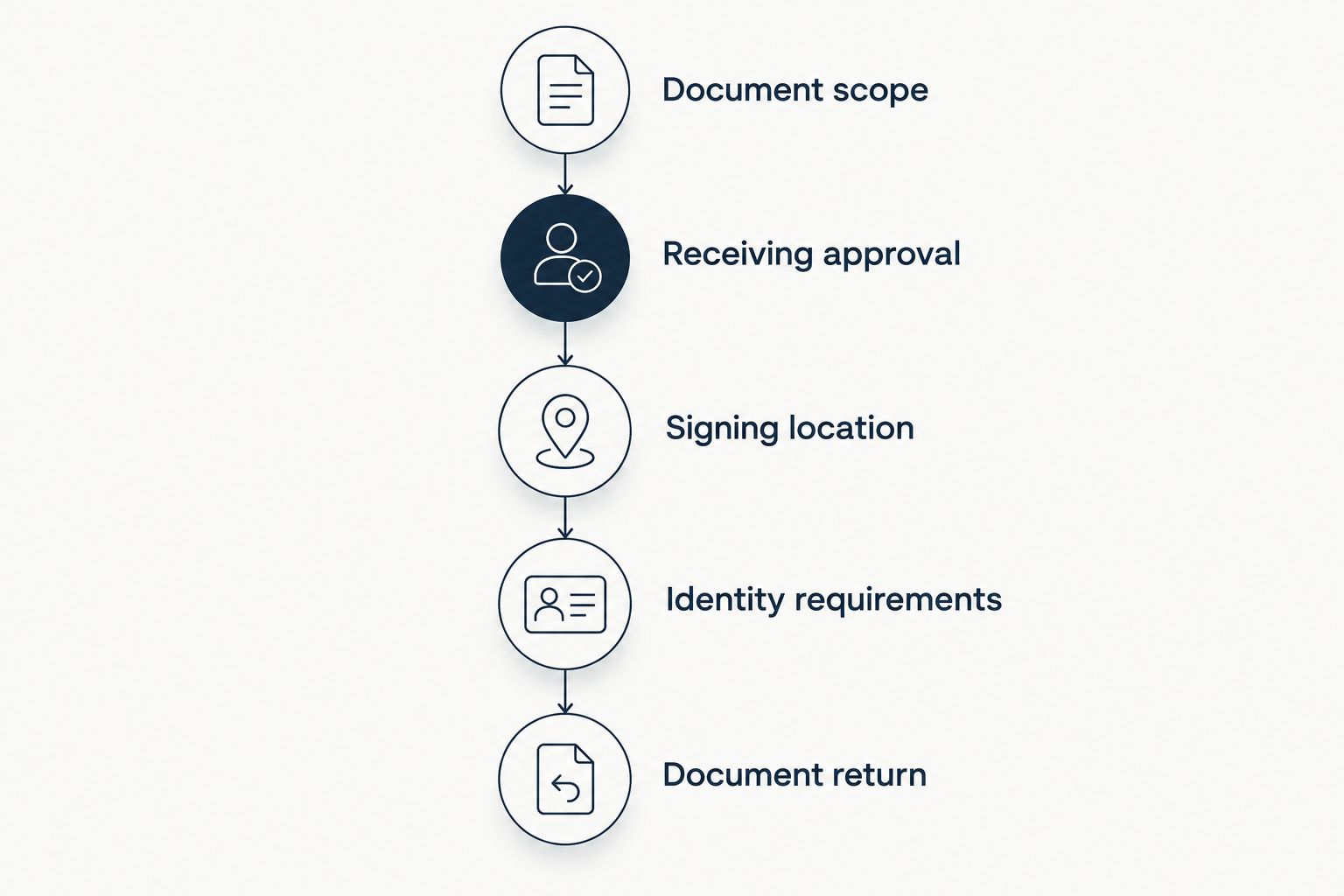
Use this sequence to turn a provider choice into a defined assignment. Keep the written instructions accessible to the signer, notary, and closing contact.
- Document scope: Identify the transaction, documents, and required notarial acts. Separate a standalone notarization from a full signing package.
- Receiving approval: Confirm the professional or service route with the responsible settlement contact. Resolve any approved-provider requirement.
- Signing location: Supply the exact address and ZIP code. Confirm access instructions and everyone who needs to attend.
- Identity requirements: Ask what identification and witnesses the appointment requires. Resolve name discrepancies before the meeting.
- Document return: Assign printing, scanbacks, original-document delivery, and problem escalation. Follow the settlement instructions rather than creating a separate process.
The sequence ends with document return because the appointment is only part of the closing workflow. A completed signing still needs the correct handoff.
Which mobile notary route should you choose?
Default to the settlement company’s approved mobile signing agent for a full real estate closing package. Choose a local commissioned mobile notary for a defined standalone act. Use a marketplace when you need professional sourcing, and treat remote notarization as a separate approval decision.
If you are undecided, send the settlement contact a short description of the proposed route and ask whether it meets the transaction’s requirements. A written answer is more useful than a general claim that a provider handles real estate documents.
FAQ
What are the best mobile notary services for real estate closings?
The best choice for a lender-directed real estate closing is a mobile signing agent approved by the title or settlement company. For a standalone notarization, choose a commissioned mobile notary authorized for the signing location and required act.
Is a mobile notary the same as a loan signing agent?
No. A mobile notary travels to perform notarial acts, while a loan signing agent handles a real estate signing assignment and its package workflow. Confirm both notarial authority and relevant closing experience.
Can I choose my own mobile notary for a home closing?
Confirm that with the title or settlement company before booking. The transaction can have an assigned-provider or approval requirement, and an independent appointment must fit the closing instructions.
Does a credential-checked marketplace guarantee lender acceptance?
No. Credential checking and lender acceptance address different requirements. Confirm the individual professional’s qualifications and the receiving party’s approval for the specific assignment.
Is remote online notarization better than an in-person mobile notary?
Remote online notarization is the right choice only when the transaction supports an authorized, accepted remote workflow. An in-person mobile appointment is the appropriate route when the closing instructions require physical attendance.
What should I prepare before a mobile closing appointment?
Prepare the signing address, document instructions, required identification, and arrangements for any necessary witnesses. Confirm who handles printing, scanbacks, and original-document return before the appointment.
Can a mobile notary tell me whether my deed is legally correct?
A notary commission does not authorize legal advice. Direct questions about drafting, ownership rights, or legal effect to an appropriate attorney or the responsible settlement contact.
One last thing
Notarization and recording are separate tasks. Before the appointment, identify who will submit the signed document and who will address a rejection or correction request. Do not let an otherwise clear signing assignment end with an undefined document handoff.