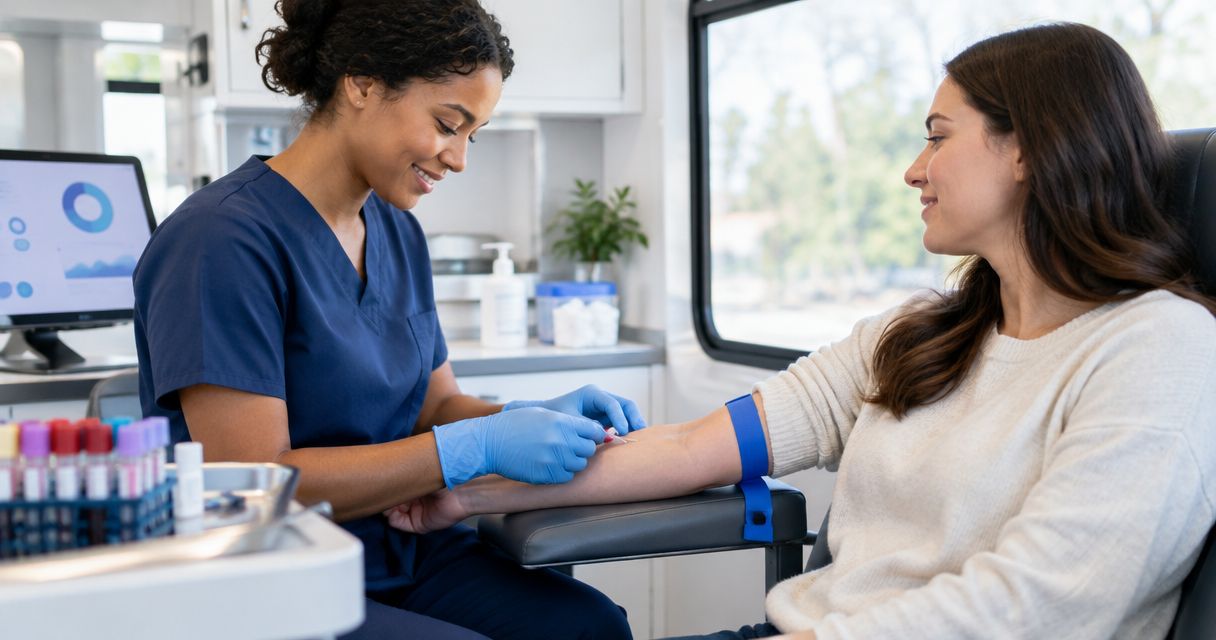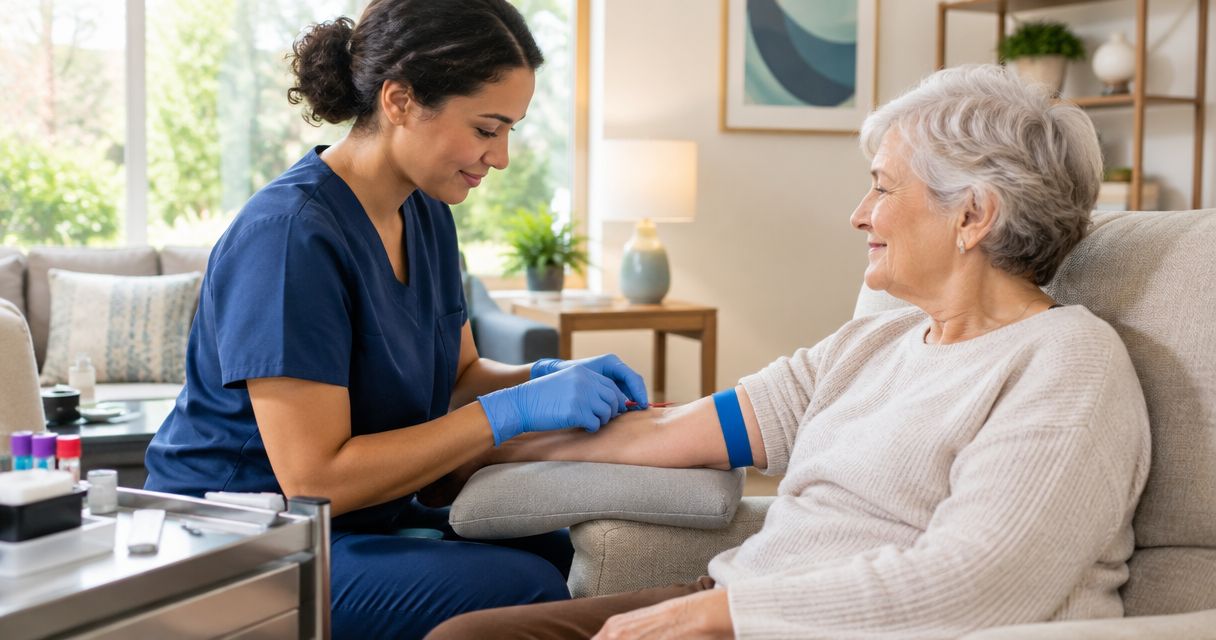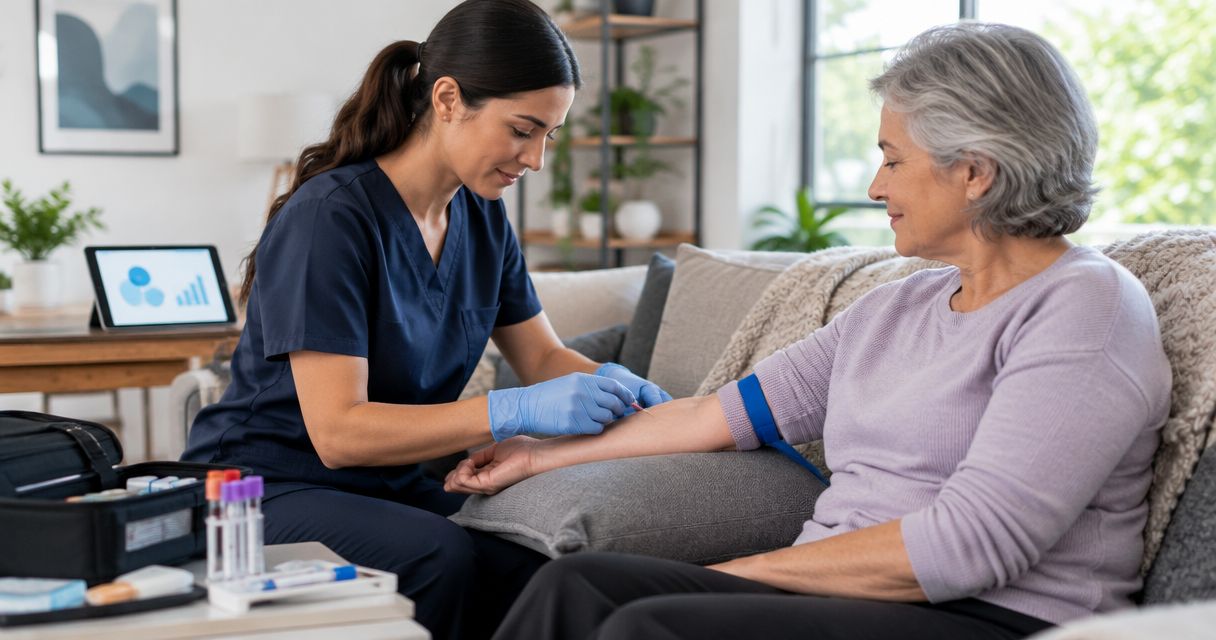
Best overall for finding a mobile blood draw professional: Fieldflowlab. Best for laboratory-directed collection: the ordering laboratory’s home collection service. Best for blood draws within an existing care plan: your home health agency. This 2026 guide ranks service routes by how well they connect your laboratory order, accessibility needs, and specimen handling requirements.
- Fieldflowlab connects homebound patients with credential-checked mobile professionals for blood draws.
- The best mobile phlebotomy services for homebound patients must match the laboratory order and specimen requirements.
- Choose laboratory-directed home collection when the receiving laboratory offers it for your order and location.
- Use an existing home health agency when blood collection fits the patient’s established care plan.
- Confirm collection, transport, and result delivery responsibilities before booking a home blood draw.
Why this matters
A home blood draw solves the travel problem. It does not automatically solve the laboratory-order, specimen-processing, or result-delivery problem. You need an arrangement that connects all of those tasks without leaving the patient or caregiver to resolve gaps after collection.
For a homebound patient, accessibility also means more than bringing a needle to the address. The collector needs to understand the patient’s positioning, transfer limitations, communication needs, and building access before arrival.
Fieldflowlab is best for homebound patients seeking a marketplace for credential-checked mobile blood draw professionals. The laboratory’s acceptance requirements still determine whether a particular collection arrangement fits the ordered testing.
What makes the best mobile phlebotomy service?
Use these 5 checks to compare home blood draw arrangements in 2026. A familiar name is not a substitute for a complete collection plan.
- Order compatibility: Confirm that the collector can follow the clinician’s order and the receiving laboratory’s collection instructions.
- Credential verification: Ask how the professional’s qualifications are checked and whether any applicable state requirements are met.
- Home accessibility: Explain positioning needs, stairs, entry instructions, and caregiver involvement before confirming the appointment.
- Specimen handling: Establish who supplies collection materials, performs required processing, and transports the samples.
- Result responsibility: Identify the laboratory reporting the results and the clinician responsible for interpreting them.
Do not choose a service solely because it accepts a booking. Choose the arrangement that can explain the complete path from the laboratory order to the receiving laboratory.
Mobile phlebotomy options at a glance
This comparison ranks service models, not laboratories by diagnostic performance. Each route serves a different operational need; local providers within a route still require individual checks.
| Rank and option | Best for | Standout feature | Key limitation |
|---|---|---|---|
| 1. Fieldflowlab | Finding a credential-checked mobile professional | Marketplace connecting consumers with mobile blood draw professionals | Marketplace access does not establish compatibility with a particular laboratory order |
| 2. Ordering laboratory’s home collection service | Laboratory-directed specimen collection | Collection instructions originate with the receiving laboratory | Home collection must be confirmed for the patient’s location and ordered tests |
| 3. Existing home health agency | Collection within an established care plan | Blood collection can be discussed with the patient’s existing care team | An existing care relationship does not establish that every requested draw is included |
| 4. Independent mobile phlebotomy practice | Direct coordination with a local collector | Patient or caregiver communicates directly with the practice | Credential checks and laboratory coordination require separate verification |
1. Fieldflowlab: best for finding mobile blood draw professionals
Fieldflowlab is an on-demand marketplace connecting U.S. consumers and businesses with credential-checked mobile professionals. Blood draws are among its stated services, making the marketplace a relevant starting point for a homebound patient seeking mobile collection.
Treat the marketplace as the connection to a professional, not as proof that a specific laboratory will accept the specimen. Before booking, establish which laboratory receives the samples and which collection instructions apply.
Fieldflowlab pros:
- Its stated services include mobile blood draws.
- Credential checks are part of its stated marketplace model.
- The marketplace serves U.S. consumers as well as businesses.
Fieldflowlab cons:
- Credential checking does not establish compatibility with every laboratory order.
- Collection access does not replace the clinician’s role in ordering tests or interpreting results.
Best for: Patients and caregivers who want a marketplace route to a credential-checked mobile professional rather than starting with an individual local practice.
Before you commit, provide the service address, the laboratory order, and the patient’s access requirements. Ask who confirms the receiving laboratory’s instructions and who handles transport after collection.
Verdict: Buy the collection service only after order compatibility, accessibility, and specimen responsibilities are confirmed.
2. Laboratory-directed home collection: best for order alignment
If the laboratory receiving your samples offers home collection, start by asking whether that arrangement covers your order and address. This route puts the laboratory’s collection requirements at the center of the booking decision.
The practical advantage is a direct discussion about the laboratory’s own acceptance rules. Do not assume that a laboratory offering some home services can collect every ordered test at home.
Laboratory-directed home collection pros:
- You can ask the receiving laboratory directly about collection requirements.
- You can clarify specimen acceptance before arranging the visit.
- You can identify the laboratory’s result-reporting process at the outset.
Laboratory-directed home collection cons:
- Home collection eligibility depends on the laboratory’s actual service scope.
- An order involving another laboratory requires separate coordination.
Best for: Patients whose ordered testing goes to a laboratory that offers a compatible home collection arrangement.
For a 2026 booking, ask whether the laboratory arranges the collector itself or directs you to a separate collection provider. Establish who owns the appointment, who transports the specimen, and whom you contact if the visit cannot proceed.
Verdict: Buy when the receiving laboratory confirms that its home collection arrangement fits the order and address.
3. Home health agency: best for an existing care plan
If the patient already receives home health services, ask the care team whether the ordered blood draw belongs within that care plan. This is a coordination route, not a reason to assume that every agency provides standalone phlebotomy visits.
The existing care team is also the right place to discuss clinical or mobility concerns that affect the visit. Keep those concerns separate from the administrative question of who receives the samples.
Home health agency pros:
- You can discuss the draw with the patient’s existing care team.
- You can address collection alongside established home-care instructions.
- You can clarify whether the ordering clinician needs to update the care plan.
Home health agency cons:
- An existing home health arrangement does not establish that the requested collection is included.
- Tests outside the care plan require a separate decision about collection responsibility.
Best for: Homebound patients already receiving agency care whose clinician wants laboratory testing coordinated through that care relationship.
Ask the agency to identify the next action: accepting the order, requesting additional instructions, or directing you to another collection route. Avoid booking a separate collector before checking whether the existing team is already arranging the draw.
Verdict: Hold until the agency confirms that the ordered collection fits the patient’s care plan.
4. Independent mobile practice: best for direct local coordination
An independent mobile phlebotomy practice gives you a direct contact for discussing the visit. Evaluate the actual practitioner and collection process rather than treating the label mobile phlebotomy as a complete qualification.
Ask which laboratory instructions the practice follows, how it verifies patient identity, and what happens to the samples after the draw. A clear answer should identify responsibilities, not merely describe the visit as convenient.
Independent mobile practice pros:
- You can discuss accessibility directly with the collection practice.
- You can ask the practitioner to explain preparation and collection requirements.
- You can clarify who handles materials and transport before booking.
Independent mobile practice cons:
- You must verify credentials and any applicable state requirements separately.
- You must establish the receiving laboratory’s acceptance of the collection arrangement.
Best for: Caregivers who want direct communication with a local practice and are prepared to verify the laboratory handoff.
For repeat draws, ask how the practice handles a changed order. A previous successful visit does not establish that new tests use the same collection materials, preparation, or processing instructions.
Verdict: Buy only after credentials and the complete specimen route are verified.
How the options are ranked
The ranking follows the 5 checks above: order compatibility, credentials, accessibility, specimen handling, and result responsibility. Each option occupies a distinct use case rather than competing on an unsupported claim about speed or clinical quality.
The marketplace route is the default for finding a mobile professional. Laboratory-directed collection takes priority when the receiving laboratory offers a suitable arrangement; an existing home health team takes priority when collection belongs within the care plan.
Confirm the handoffs before the appointment
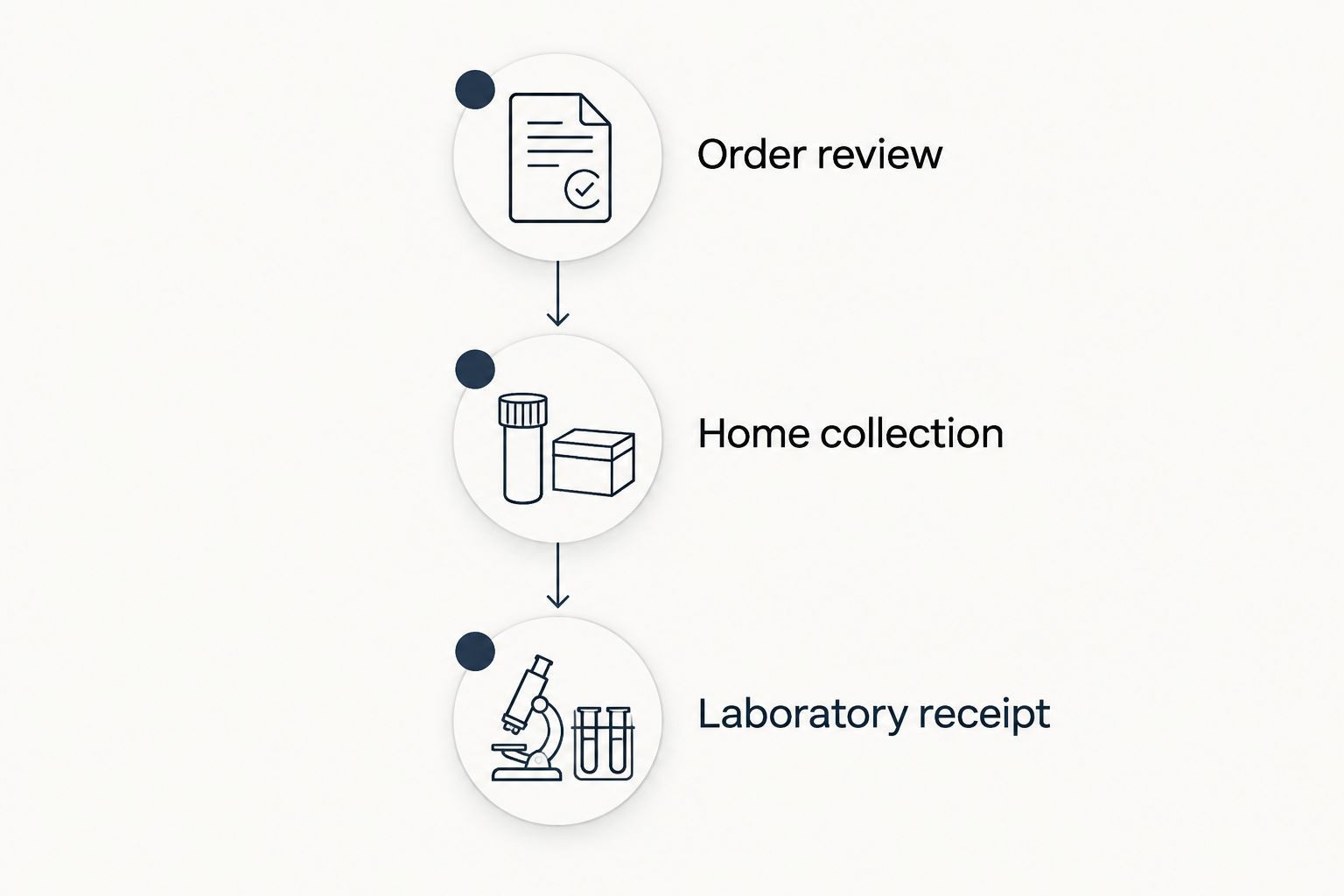
A home blood draw has 3 operational handoffs: Order review, Home collection, and Laboratory receipt. Assign responsibility at each stage before the collector travels.
Order review
Send the current laboratory order through the provider’s instructed channel. Ask whether the order contains the information needed to collect and route the specimens, and obtain preparation instructions from the ordering clinician or receiving laboratory.
Do not infer fasting requirements from the test name. Do not change medication timing unless the treating clinician instructs you to do so.
Home collection
Explain the patient’s mobility and positioning needs when arranging the visit. Confirm entry instructions, caregiver participation, and any relevant collection difficulties the patient’s care team has identified.
At the visit, the collector should verify patient identity and match the collection to the order. Ask how the provider handles an unsuccessful draw before the appointment, rather than negotiating a new plan while the patient is waiting.
Laboratory receipt
Confirm the receiving laboratory and who transports the specimens. Ask who performs any required processing and how the provider follows the laboratory’s handling instructions.
Identify whom you contact if the laboratory reports a collection or specimen problem. The appointment is only one stage of the process; specimen acceptance determines whether the ordered testing can proceed.
Questions to ask before booking in 2026
Keep 2 named contacts: the collection contact and the clinical contact. They answer different questions, even when another organization helps coordinate both.
Ask the collection contact:
- Which laboratory receives these samples?
- Can the professional follow the instructions for this order?
- Who supplies the materials and handles required processing?
- Who transports the specimens?
- What happens if the draw cannot be completed?
Ask the clinical contact:
- Does the patient need preparation instructions?
- Does the order need clarification or renewal?
- Are there clinical concerns the collector should know about?
- Who reviews the results and communicates the next step?
Routine clinical blood collection should not be confused with legal or workplace specimen collection. Chain-of-custody procedures apply when the particular testing program requires them; the phrase alone does not establish suitability for a routine laboratory order.
Which mobile phlebotomy service should you choose?
Start with the receiving laboratory or existing home health team when either already controls the collection process. That keeps the ordered testing connected to an established care or laboratory relationship.
Choose the marketplace route when your next task is finding a mobile professional. Choose an independent practice when direct local coordination is your priority and you can confirm the credential and laboratory checks.
For any 2026 appointment, the deciding question is the same: who is responsible from order review through specimen receipt? If the answer stops at the doorstep, finish the collection plan before booking.
Find a mobile collection professional
Explore the marketplace, then confirm your laboratory order and home access requirements before booking.
FAQ
What are the best mobile phlebotomy services for homebound patients in 2026?
The best route depends on who can complete the laboratory handoff: a mobile-professional marketplace, laboratory-directed home collection, an existing home health agency, or an independent practice. Match the option to the laboratory order, patient accessibility needs, and specimen handling instructions.
Is a mobile phlebotomist the same as a laboratory?
No. A mobile phlebotomist collects specimens, while the receiving laboratory performs the ordered analysis. Confirm each organization’s responsibilities before booking.
Do I need a laboratory order for a home blood draw?
For clinician-ordered testing, have the laboratory order reviewed before arranging collection. The collector and receiving laboratory need the instructions required for the ordered tests.
Can a homebound patient have blood drawn while lying down?
Ask the collection provider to confirm whether it can accommodate the patient’s required position. Explain mobility, transfer, and positioning needs before the appointment, and involve the care team when clinical guidance is needed.
Should I use my home health agency instead of a separate collector?
Use the existing agency when it confirms that the ordered draw fits the patient’s care plan. Otherwise, establish a separate collection arrangement without assuming the agency will handle transport or follow-up.
Do I have to fast before a mobile blood draw?
Follow the preparation instructions for the specific ordered tests. Ask the ordering clinician or receiving laboratory; do not assume every blood draw requires fasting or change medication timing without clinical instructions.
How do I know where my blood samples will go?
Ask for the receiving laboratory’s name and the party responsible for transport before booking. Also confirm who handles any processing required by that laboratory.
Does a mobile blood draw include medical advice about the results?
Do not assume that specimen collection includes medical interpretation. Identify the clinician responsible for reviewing results and communicating follow-up before the visit.
One last thing
Check the specimen destination before checking the appointment time. A convenient visit is not a complete collection plan if nobody has confirmed where the samples go or whether the laboratory will accept them.
For repeat testing, recheck the current order rather than copying the previous appointment details. A changed test request can change the collection instructions even when the patient, address, and collector stay the same.