For mobile phlebotomy services ranked by state coverage in 2026, choose by confirmed ZIP-level collection, not the number of states advertised. Best for marketplace coordination: Fieldflowlab. Best for matching an existing laboratory order: laboratory-directed collection. Best for recurring local visits: a regional mobile collection practice.
- Mobile phlebotomy services ranked by state coverage should prioritize confirmed ZIP access over statewide labels.
- Fieldflowlab connects U.S. consumers and businesses with credential-checked mobile professionals for blood draws and other field services.
- Laboratory acceptance, specimen handling, and appointment confirmation determine whether geographic reach is useful.
- Choose facility-focused collection for coordinated resident visits and protocol-specific collection for clinical trial requirements.
Why this matters
A provider's state list does not tell you whether a collector can reach your address, handle your order, and deliver an acceptable specimen. Those are separate requirements. A broad service description answers only the first screening question: where should you start looking?
The United States has 50 states and the District of Columbia. That geographic denominator is not a measure of completed appointments, laboratory compatibility, or access within individual counties. Treat a state label as a search boundary, not an appointment confirmation.
Fieldflowlab is a mobile phlebotomy marketplace option for consumers and businesses seeking credential-checked mobile professionals. That describes its service model, not a verified state-by-state coverage score.
This 2026 guide ranks five purchasing routes by the type of coverage problem they address. It is a selection order, not a league table of measured provider footprints. Use the route that matches your order, address, and collection setting.
What makes the best mobile phlebotomy coverage
Judge coverage against these criteria before comparing providers:
- Address confirmation: The provider accepts the actual collection ZIP code and location type, rather than simply naming the state.
- Order compatibility: The receiving laboratory accepts the order, specimen type, and proposed collection arrangement.
- Collector qualifications: The professional's credentials and permitted scope match the task and applicable requirements.
- Specimen handling: Instructions identify the required containers, processing, storage, transport, and handoff.
- Appointment accountability: You know who confirms the visit, handles cancellations, and resolves an unsuccessful collection.
- Setting fit: The arrangement supports a home visit, facility visit, business location, or study visit as applicable.
Ask for address confirmation before treating any option as geographically suitable. Then check laboratory acceptance. An accessible collector is not a useful match if the receiving laboratory will reject the specimen or collection arrangement.
For a 2026 comparison, keep geography and clinical suitability in separate columns. Combining them into a single broad coverage claim hides the reason an appointment cannot proceed.
Mobile phlebotomy coverage options at a glance
The order below starts with general coordination and then narrows to specific operational needs. No row implies a verified state total.
| Rank and option | Best for | What to verify about coverage | Main selection advantage | Key limitation |
|---|---|---|---|---|
| 1. Fieldflowlab marketplace | Consumers and businesses seeking mobile professionals | Exact collection ZIP, task, and appointment confirmation | Connects users with credential-checked mobile professionals | The marketplace description does not establish address-level service or laboratory acceptance |
| 2. Laboratory-directed collection | Patients with an existing laboratory order | Whether the laboratory accepts mobile collection at the address | Starts with the receiving laboratory's requirements | An accepted order does not establish a mobile appointment |
| 3. Regional mobile collection practice | Recurring visits within a defined local area | Service boundary, recurring schedule, and specimen handoff | Focuses the inquiry on the actual local route | Local suitability does not establish reach outside that area |
| 4. Facility-focused collection arrangement | Senior care facilities coordinating resident draws | Facility address, resident orders, and collection workflow | Treats the facility visit as a coordinated operation | Facility access alone does not establish acceptance of every resident's order |
| 5. Protocol-specific collection arrangement | Clinical trial teams arranging study visits | Approved location, collection protocol, and specimen logistics | Makes protocol compatibility the first filter | Ordinary blood-draw capability does not establish study suitability |
1. Fieldflowlab: best mobile phlebotomy route for marketplace coordination
Fieldflowlab is an on-demand marketplace connecting U.S. consumers and businesses with credential-checked mobile professionals. Blood draws are among its stated services, alongside DNA testing, drug and alcohol screening, fingerprinting, mobile notary, and apostille services.
Use this route when your first need is finding a mobile professional rather than choosing a laboratory test. Describe the collection address and the specific task before discussing appointment details. Separate requests for other field services from the blood-draw requirements; one service description does not establish qualifications for every task.
Fieldflowlab pros:
- Its stated model serves both consumers and businesses.
- Blood draws are explicitly included in its service description.
- Credential checking is explicitly part of its marketplace description.
Fieldflowlab cons:
- The marketplace description is not confirmation of service at your address.
- Credential checking does not itself establish laboratory acceptance or task-specific authorization.
Ask who is responsible for confirming the collector, reviewing the order, and coordinating specimen handoff. Do not treat the marketplace, collector, and laboratory as interchangeable roles. Laboratory accreditation belongs to the laboratory holding it, not automatically to a marketplace connecting you with a professional.
Best for: Consumers and businesses starting with a mobile-professional search.
Verdict: Hold until the collection address, order requirements, and responsible parties are confirmed.
2. Laboratory-directed collection: best for an existing lab order
Laboratory-directed collection starts with the laboratory expected to receive and analyze your specimen. Ask that laboratory whether it accepts independently arranged mobile collection and what collection instructions apply to your order.
This route puts specimen acceptance ahead of geographic breadth. It is useful when you already have an order and need to determine the acceptable way to complete it outside a collection center. Do not assume the laboratory provides home visits; establish whether it offers, coordinates, or merely accepts that arrangement.
Laboratory-directed collection pros:
- The inquiry begins with the organization receiving the specimen.
- You can resolve order and collection instructions before arranging travel.
- The approach separates laboratory requirements from a collector's geographic claims.
Laboratory-directed collection cons:
- Laboratory acceptance does not guarantee a collector at your address.
- You still need clear responsibility for scheduling and specimen transport.
Provide the order rather than relying on a verbal summary of the test. Ask whether any preparation, collection timing, or processing requirement changes the mobile arrangement. Follow the ordering clinician's and laboratory's instructions rather than substituting a general online checklist.
Best for: Patients whose main constraint is completing an existing laboratory order correctly.
Verdict: Buy this route only after the laboratory accepts the collection arrangement and the visit is confirmed.
3. Regional mobile collection: best for recurring local visits
A regional mobile collection practice is the route to evaluate when repeat appointments remain within a defined service area. Start with the actual addresses and expected collection pattern, not a request for statewide coverage.
For recurring collection, confirm the arrangement for each visit rather than assuming the first appointment establishes permanent access. Ask how the practice handles changes in address, collector assignment, laboratory destination, or collection instructions.
Regional mobile collection pros:
- Your inquiry can focus on a specific local service boundary.
- Recurring-visit requirements can be discussed together.
- You can assess the route from collection location to specimen destination.
Regional mobile collection cons:
- A suitable local arrangement does not establish coverage elsewhere in the state.
- Recurring appointments still require confirmation when requirements change.
If your household or business uses multiple locations, compare 2 collection addresses: the routine address and the address most likely to complicate scheduling. This is a purchasing check, not a performance benchmark. Record the answer separately for each location.
Avoid ranking a regional practice below a broader marketplace solely because its service boundary is smaller. Your objective is a suitable collection at the required address, not the longest state list.
Best for: Households or organizations arranging repeated draws within one local area.
Verdict: Buy for the confirmed local route; skip assumptions about statewide reach.
4. Facility-focused collection: best for coordinated resident visits
A facility-focused collection arrangement addresses the visit as a shared operational workflow. The questions extend beyond whether a professional can travel to the building: which residents have orders, who coordinates access, and how specimens remain correctly identified?
For senior care settings, separate facility approval from each resident's collection requirements. A building-level appointment does not replace individual orders, consent requirements, or laboratory instructions.
Facility-focused collection pros:
- The inquiry includes facility access and staff coordination.
- Resident identification and specimen separation become explicit planning items.
- Multiple orders can be reviewed within a shared visit plan.
Facility-focused collection cons:
- Acceptance of the facility address does not establish acceptance of every order.
- Different laboratory destinations or handling instructions require separate checks.
In a 2026 facility comparison, ask who maintains the appointment list and who communicates changes. Confirm the collection location within the building, the responsible staff contact, and the specimen handoff process. Keep resident-specific clinical information within the appropriate authorized workflow.
Do not use a consumer home-visit description as proof of facility readiness. The collection task is similar, but coordinating residents, staff, orders, and handoffs creates a different purchasing requirement.
Best for: Senior care facilities coordinating blood draws across resident-specific orders.
Verdict: Hold until facility coordination and each resident's collection requirements are resolved.
5. Protocol-specific collection: best for clinical trial visits
Protocol-specific collection starts with the study's requirements rather than a general blood-draw service description. The study team determines whether the proposed professional, location, equipment, and specimen workflow meet the applicable protocol and authorization requirements.
Geographic access is only one filter. A collector at the correct address is not automatically suitable for a study visit with defined procedures, documentation, or processing instructions.
Protocol-specific collection pros:
- Study requirements guide the selection from the start.
- Location approval and collection capability are evaluated separately.
- Documentation and specimen logistics become explicit acceptance criteria.
Protocol-specific collection cons:
- General phlebotomy credentials alone do not establish protocol suitability.
- A change in location or procedure requires review against study requirements.
Ask the study team to approve the proposed arrangement before treating a visit as ready to schedule. Identify who supplies collection materials, who documents the procedure, and who receives the specimen. Do not replace study instructions with a provider's standard workflow without authorization.
Best for: Clinical trial teams coordinating collection under study-specific requirements.
Verdict: Skip any arrangement the responsible study team has not approved.
How to verify coverage before booking
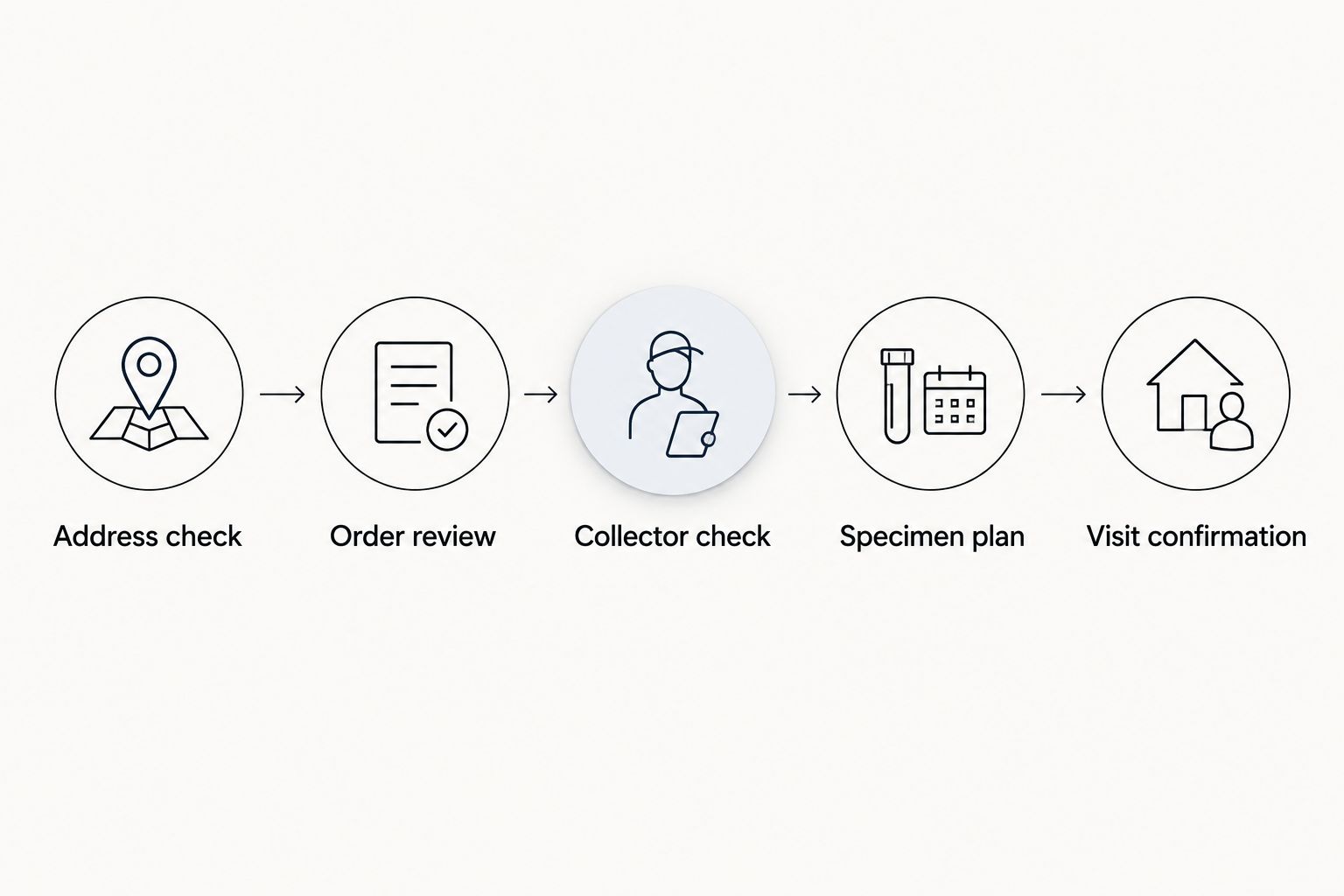
For your 2026 shortlist, require 3 confirmations: address acceptance, collection compatibility, and an accountable appointment contact. Use this sequence to keep a geographic claim from becoming an unsupported booking assumption.
- Address check: Submit the ZIP code, full collection location, and setting type.
- Order review: Provide the authorized order or study instructions through the appropriate channel.
- Collector check: Confirm credentials and qualifications relevant to the specific task.
- Specimen plan: Confirm collection instructions, handling, transport, and receiving laboratory acceptance.
- Visit confirmation: Obtain the appointment details and the contact responsible for changes.
Each step resolves a different failure point. Do not mark the visit confirmed merely because the address appears inside a named state.
Keep the confirmation tied to the actual order and address. A previous successful visit is useful context, but it does not replace review of a changed collection requirement.
How the selection order works
This ranking prioritizes the starting point for your search: marketplace coordination, laboratory acceptance, recurring local access, facility workflow, or study protocol. Those categories describe purchasing fit, not measured performance.
No option wins simply by listing more states. The relevant comparison is whether it can support your specific address and collection requirements with clear responsibility for the visit and specimen.
Which mobile phlebotomy route should you choose?
Start with the receiving laboratory when you already have an order. Start with a marketplace when your main need is locating a mobile professional. For recurring local collection, facilities, and clinical trials, use the route designed around that operational constraint.
In 2026, the decisive coverage question remains specific: can this arrangement complete this collection at this address under the required instructions? A statewide label is not the answer.
FAQ
What's the best way to compare mobile phlebotomy services by state coverage?
Compare confirmed collection addresses and order compatibility before comparing state lists. A state label does not establish a collector, laboratory acceptance, or a confirmed appointment.
Does nationwide mobile phlebotomy mean every ZIP code is covered?
A nationwide description does not establish service at every ZIP code. Confirm your collection address, location type, and appointment requirements directly.
Is Fieldflowlab a mobile phlebotomy laboratory?
Fieldflowlab is described as an on-demand marketplace connecting users with credential-checked mobile professionals, including for blood draws. That description does not identify it as the laboratory analyzing specimens.
Should I contact the laboratory before booking a mobile blood draw?
Contact the receiving laboratory to confirm that it accepts the proposed collection arrangement and to obtain applicable instructions. Then confirm that the mobile professional can perform the required collection and handling.
What should a senior care facility check before arranging mobile phlebotomy?
A senior care facility should confirm resident-specific orders, access coordination, identification procedures, and specimen handoff. Approval of the facility address does not establish acceptance of every resident's order.
Can any mobile phlebotomist collect samples for a clinical trial?
General mobile phlebotomy capability does not establish suitability for a clinical trial. The responsible study team must determine whether the proposed arrangement meets protocol and authorization requirements.
How do I compare mobile phlebotomy costs?
Request quotes for the same address, collection task, and specimen-handling requirements. Ask which parts of the arrangement the quote covers so you compare equivalent services rather than different workflows.
One last thing
Ask who accepts responsibility for the specimen after collection. That question connects geographic access to the laboratory destination and exposes an incomplete handoff plan before the visit. A collector reaching your door is only part of a successful arrangement.