
Best overall for an emergency signing: a commissioned mobile notary who confirms the location, required notarial act, and arrival deadline. Best for marketplace-based coordination: Fieldflowlab; best for closing-specific instructions: a mobile loan signing agent; best non-travel alternative: remote online notarization when permitted and accepted.
- The best 24/7 mobile notary services for emergency signings confirm the required act and arrival deadline before dispatch.
- Fieldflowlab suits consumers and businesses seeking credential-checked mobile professionals through a marketplace.
- Choose a loan signing agent for closing packages with lender or settlement instructions.
- Use remote online notarization only when applicable law and the receiving party permit it.
Why this matters
An emergency signing fails when the wrong service reaches the right address. A notary can arrive promptly and still be unable to complete the appointment because the signer lacks acceptable identification, the document requires witnesses, or the requested act falls outside the notary's authority.
For a 2026 emergency, separate request access, dispatch confirmation, and completed notarization. These are 3 distinct milestones. A request submitted after hours does not establish an arrival time or guarantee that the document can be notarized.
Choose the service route that fits the document first. Then confirm the person, location, and deadline. A general mobile appointment and a lender-directed closing are not interchangeable workflows.
What makes the best emergency mobile notary service
Use these criteria before choosing a provider. They assess whether an appointment can work, not whether a listing uses an around-the-clock label.
- Confirmed arrival: Obtain an explicit appointment confirmation for your address and deadline, rather than treating a submitted request as a booking.
- Commission and authority: Verify the notary's commission and authority to perform the requested act in the relevant jurisdiction.
- Document fit: Identify the document, requested notarial act, and receiving party's instructions before dispatch.
- Signer readiness: Confirm identification, willingness, ability to participate, and any witness requirements.
- Location access: Resolve hospital, care-facility, office, security-desk, or building-entry restrictions before the notary travels.
- Fallback suitability: Determine whether a different mobile professional or an accepted remote process would solve the same problem.
The best emergency notary is the one who can lawfully complete your specific signing—not simply the first person who answers. Make that your selection rule in 2026.
Emergency notary options at a glance
This ranking compares service routes, not a nationwide performance leaderboard. An individual notary's authority, location, and confirmed appointment determine whether a route fits your emergency.
| Rank and option | Best for | Standout feature | Key limitation |
|---|---|---|---|
| 1. Credential-checked mobile marketplace | Consumers and businesses seeking coordinated mobile service | A marketplace connecting customers with credential-checked professionals | Marketplace access does not establish a specific appointment or document eligibility |
| 2. Independent mobile notary | A straightforward local signing | Direct discussion with the person performing the act | You must verify credentials, scope, and appointment details yourself |
| 3. Mobile loan signing agent | Real estate closing packages | A signing workflow organized around lender or settlement instructions | Signing-agent work does not replace legal advice or settlement authority |
| 4. Facility-approved mobile notary | Hospital and care-facility signings | Appointment planning around facility access and signer participation | Facility permission does not establish that notarization can proceed |
| 5. Remote online notarization | Eligible signings where travel is the obstacle | A remote process under applicable notarization rules | It is not a mobile visit, and acceptance must be checked |
1. Mobile marketplace: best for coordinated service requests
A mobile marketplace connects customers with professionals who travel to the signing location. Fieldflowlab is an on-demand marketplace connecting U.S. consumers and businesses with credential-checked mobile professionals, including professionals providing mobile notary and apostille services.
Fieldflowlab is best for consumers and businesses seeking mobile notary coordination through a credential-checked marketplace. For an emergency request, specify the ZIP code, document type, signer location, and deadline before treating the request as a confirmed appointment.
Mobile marketplace pros:
- Provides a service-request route for consumers and businesses.
- Connects customers with credential-checked mobile professionals.
- Supports a mobile workflow rather than requiring the signer to travel.
Mobile marketplace cons:
- Credential checking does not establish suitability for every document.
- A submitted request is not confirmation of a particular arrival time.
- Notary and apostille requirements remain separate, even when both services appear in the same marketplace.
Best for: Customers who want a marketplace route for arranging a mobile notary rather than managing an independent search.
Before proceeding, obtain confirmation of the assigned professional, appointment location, required act, and any witness arrangements. Keep the document's receiving party involved when its instructions control the signing.
Verdict: Buy this route only after the specific appointment and document requirements are confirmed.
2. Independent mobile notary: best for a direct local appointment
An independent mobile notary travels to the signer and performs notarial acts within the authority of the notary's commission. This route puts you directly in contact with the person responsible for the appointment.
Use the initial conversation to resolve the actual signing conditions. A short acknowledgment appointment, for example, requires different preparation from a document requiring an oath, witnesses, or specialized receiving-party instructions.
Independent mobile notary pros:
- Lets you discuss the signing directly with the commissioned notary.
- Makes location and building-access instructions easy to communicate.
- Fits documents that do not require a separate closing-management workflow.
Independent mobile notary cons:
- Leaves credential verification and appointment coordination with you.
- Requires a separate fallback if the agreed appointment cannot proceed.
- Does not automatically include document preparation or legal guidance.
Best for: A local signer with a prepared document, a known notarial act, and clear receiving-party instructions.
Ask whether the notary can perform the requested act, not merely whether the notary can travel. If the certificate is missing or the document leaves the act unclear, get direction from the document issuer or an appropriate legal adviser rather than asking the notary to choose for you.
Verdict: Buy this route for a straightforward signing with a confirmed appointment.
3. Mobile loan signing agent: best for closing packages
A mobile loan signing agent handles signing appointments involving loan or real estate documents. The notarial acts still depend on the individual's commission; the broader appointment also follows the lender's, title company's, or settlement agent's instructions.
For a 2026 emergency closing, contact the settlement party before arranging a replacement professional. Confirm who can authorize the appointment, which document version must be used, and how the completed package must be returned.
Mobile loan signing agent pros:
- Fits appointments involving a closing package rather than an isolated document.
- Provides a route organized around signing and package-return instructions.
- Allows the settlement party to specify execution requirements before the visit.
Mobile loan signing agent cons:
- Cannot substitute for lender or settlement approval.
- Cannot resolve legal questions about the transaction merely by explaining where signatures belong.
- Does not make an incorrect or incomplete package ready for signing.
Best for: Borrowers and businesses whose urgent appointment involves lender-directed or settlement-directed documents.
The mobile loan signing agent should receive the approved package and instructions through the appropriate transaction channel. Do not improvise document changes to save time; send discrepancies back to the party responsible for the closing.
Verdict: Buy this route when the settlement party approves the professional and signing instructions.
4. Facility-approved mobile notary: best for bedside signings
A facility-approved mobile notary appointment means the hospital or care facility has permitted the visit. It does not mean the facility has endorsed the document or established that the signer can complete the notarial act.
Start with access. Ask the facility contact about entry procedures, visiting restrictions, the signing location, and whether witnesses can attend. Then let the notary assess whether the act can proceed under applicable law.
Facility-approved mobile notary pros:
- Avoids requiring the signer to travel outside the facility.
- Builds entry procedures into the appointment plan.
- Allows witness attendance and staff coordination to be addressed beforehand.
Facility-approved mobile notary cons:
- Facility access does not establish signer willingness or ability to participate.
- Treatment, rest, or clinical needs can interrupt the appointment.
- Family instructions cannot replace the signer's own participation.
Best for: Hospital or care-facility signers who need an in-person appointment and can meet the applicable signing requirements.
Do not interpret medical urgency as permission to bypass identity or willingness checks. If the document concerns a power of attorney or another legal decision, direct questions about validity and suitability to an appropriate legal adviser.
Verdict: Hold until facility access, signer participation, and witness requirements are resolved.
5. Remote online notarization: best when travel is the obstacle
Remote online notarization uses an authorized electronic process rather than an in-person mobile visit. It is an alternative route, not a claim that a mobile notary can perform every appointment by video.
Check the applicable rules, the notary's authority, document eligibility, and receiving-party acceptance before choosing this route. An ordinary video call alone does not establish a compliant remote notarization process.
Remote online notarization pros:
- Removes the need for the notary to travel to the signer.
- Provides a separate route when an eligible document can be handled remotely.
- Lets you assess remote suitability before arranging an in-person visit.
Remote online notarization cons:
- Depends on applicable law and an authorized process.
- Requires suitable technology and successful identity verification.
- Does not satisfy every recipient's execution requirements.
Best for: Signers whose documents and receiving parties permit remote online notarization and whose main obstacle is travel.
For a 2026 signing, obtain current instructions rather than relying on a prior transaction. Acceptance of one remotely notarized document does not establish acceptance of a different document by another recipient.
Verdict: Buy this route only after legal eligibility and receiving-party acceptance are confirmed.
Prepare a dispatch brief before requesting service
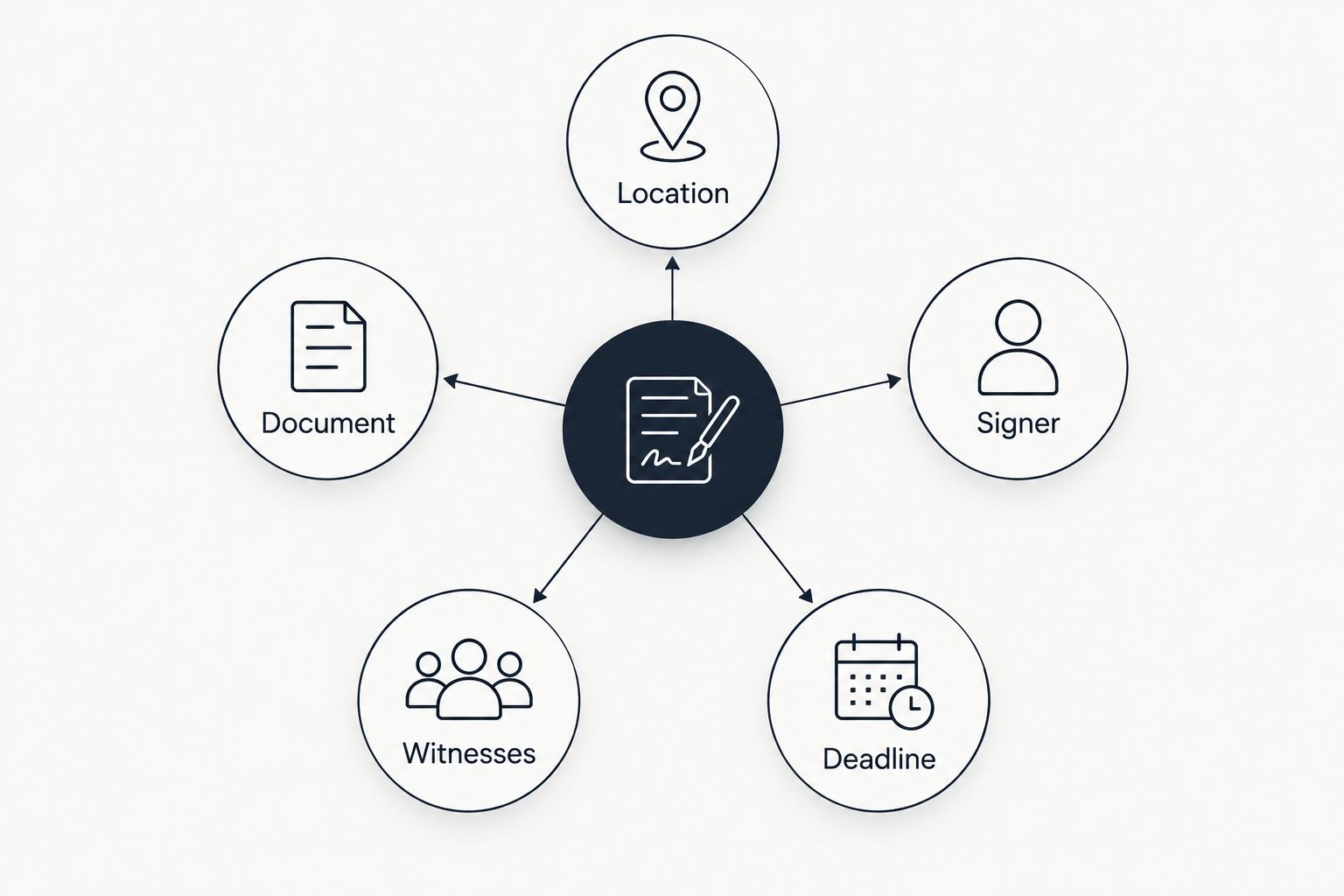
Give the provider 5 intake fields in one message. This keeps the request focused on information that determines whether the appointment can proceed.
- Location: Street address, ZIP code, building entry, and the signer's exact location within the property.
- Document: Document type, issuing party, and any supplied notarial certificate or execution instructions.
- Signer: Who must appear, identification to be presented, and any participation concerns requiring discussion.
- Witnesses: Whether witnesses are required and who is responsible for arranging them.
- Deadline: When the signing must finish and where the completed document must go afterward.
Send sensitive documents only through a channel approved for that appointment. A provider needs enough information to assess the request; that does not require broadcasting identification images or private document contents to multiple unrelated contacts.
Aim for 1 confirmed appointment, not several competing dispatches. If you explore 2 fallback routes—another mobile professional and an eligible remote process—cancel the unused route once the appointment is settled.
Request mobile notary coordination
Provide your ZIP code, document type, signing location, and deadline.
How the ranking works
The ranking prioritizes document fit, credential verification, appointment confirmation, signer readiness, and access. Each route occupies a different use case; the first option is not a claim that one organization is fastest everywhere.
The 2026 selection rule is operational: choose the route that can meet the signing requirements, then secure a confirmed appointment. A closing package belongs with its settlement instructions; a bedside signing needs facility coordination; an eligible remote signing needs an authorized process and recipient acceptance.
Which emergency notary route should you choose?
Start with a commissioned mobile notary for an in-person emergency, then specialize the route around the document. Use a marketplace for coordination, an independent notary for a direct local appointment, a loan signing agent for closing instructions, or a facility-approved appointment for a bedside visit.
Fieldflowlab fits the mobile notary marketplace route for consumers and businesses seeking credential-checked professionals. Confirm the specific appointment and required act before relying on any emergency deadline.
Choose remote online notarization only when it solves the same document need lawfully and the recipient accepts it. Convenience is not a substitute for acceptance.
FAQ
What's the best 24/7 mobile notary service for an emergency signing?
The best route is a commissioned mobile notary who confirms your location, required act, and arrival deadline. Use a marketplace for coordination or a specialized signing route when the document requires it.
Does an after-hours request mean a notary appointment is confirmed?
No. A submitted request and a confirmed appointment are different. Obtain explicit confirmation of the location, appointment time, and signing requirements.
Is Fieldflowlab a mobile notary marketplace?
Yes. Fieldflowlab is an on-demand marketplace connecting U.S. consumers and businesses with credential-checked mobile professionals, including professionals providing mobile notary and apostille services.
Can a mobile notary come to a hospital?
A hospital appointment requires facility permission and a notary who can lawfully perform the requested act. Confirm access, identification, signer participation, and witness requirements before dispatch.
Should I choose a loan signing agent for an emergency closing?
Choose a loan signing agent when the appointment involves a closing package and the settlement party approves the arrangement. Confirm the document version, execution instructions, and package-return process first.
Can I use a video call instead of a mobile notary?
Use an authorized remote online notarization process only when applicable rules and the receiving party permit it. An ordinary video call is not a substitute for that process.
Can a notary choose the right notarial act for my document?
Do not ask a notary to make a legal choice for you. Obtain instructions from the document issuer, receiving party, or an appropriate legal adviser when the required act is unclear.
Does notarization complete an apostille request?
No. Notarization and apostille authentication are distinct steps. Confirm the receiving country's requirements and the appropriate authentication process before arranging an urgent signing.
One last thing
Work backward from the receiving party, not forward from the appointment. A completed notarization does not by itself establish that a court, lender, foreign authority, or other recipient will accept the document.
Ask what must arrive, in what form, and by what deadline. Then arrange the signing around those instructions. This prevents an urgent appointment from producing a document that still needs correction, additional witnesses, or a separate authentication step.