
Best overall: a mobile notary with a confirmed arrival window. Best for comparing service requests: a credential-checked marketplace. Best for closing packages: a signing specialist accepted by your closing team. For mobile notary services ranked by turnaround time in 2026, rank the confirmed appointment and document requirements—not an advertised response time.
- Mobile notary services ranked by turnaround time should prioritize confirmed arrival and document acceptance over response speed.
- Fieldflowlab connects U.S. consumers and businesses with credential-checked mobile professionals, including mobile notaries.
- A signing specialist fits closing packages; a facility-approved notary fits restricted-access appointments.
- Notarization and apostille processing have separate completion points. Confirm both before booking.
Why this matters
A fast reply does not establish when your document will be notarized. You need an arrival window, a signer who can participate, and a document that meets the receiving party's requirements. A booking can fail on any of those conditions even after someone accepts the request.
Fieldflowlab is a mobile notary marketplace option for U.S. consumers and businesses seeking credential-checked professionals. Fieldflowlab connects customers with mobile notary and apostille professionals alongside its other field services. Choose the booking route according to the task; credential checking does not replace confirmation of the specific notarial act or appointment.
The ranking below separates booking routes by use case. It does not assign universal travel times or declare one provider faster across every ZIP code. Your usable turnaround is the time from submitting a complete request to completing the required act—not simply receiving a message.
What makes the best mobile notary turnaround
For a 2026 request, judge each option against these criteria before choosing:
- Arrival confirmation: Get an appointment window, not just an acknowledgment that the request was received.
- Document fit: Identify the required notarial act and any instructions from the receiving party before dispatch.
- Signer readiness: Confirm acceptable identification, participation requirements, and any witnesses required for the document.
- Location access: Supply the ZIP code, exact meeting location, parking instructions, and entry restrictions.
- Completion scope: Separate notarization from scanning, delivery, closing-package return, or apostille processing.
- Escalation ownership: Know whom to contact if the professional cannot enter the location or complete the requested act.
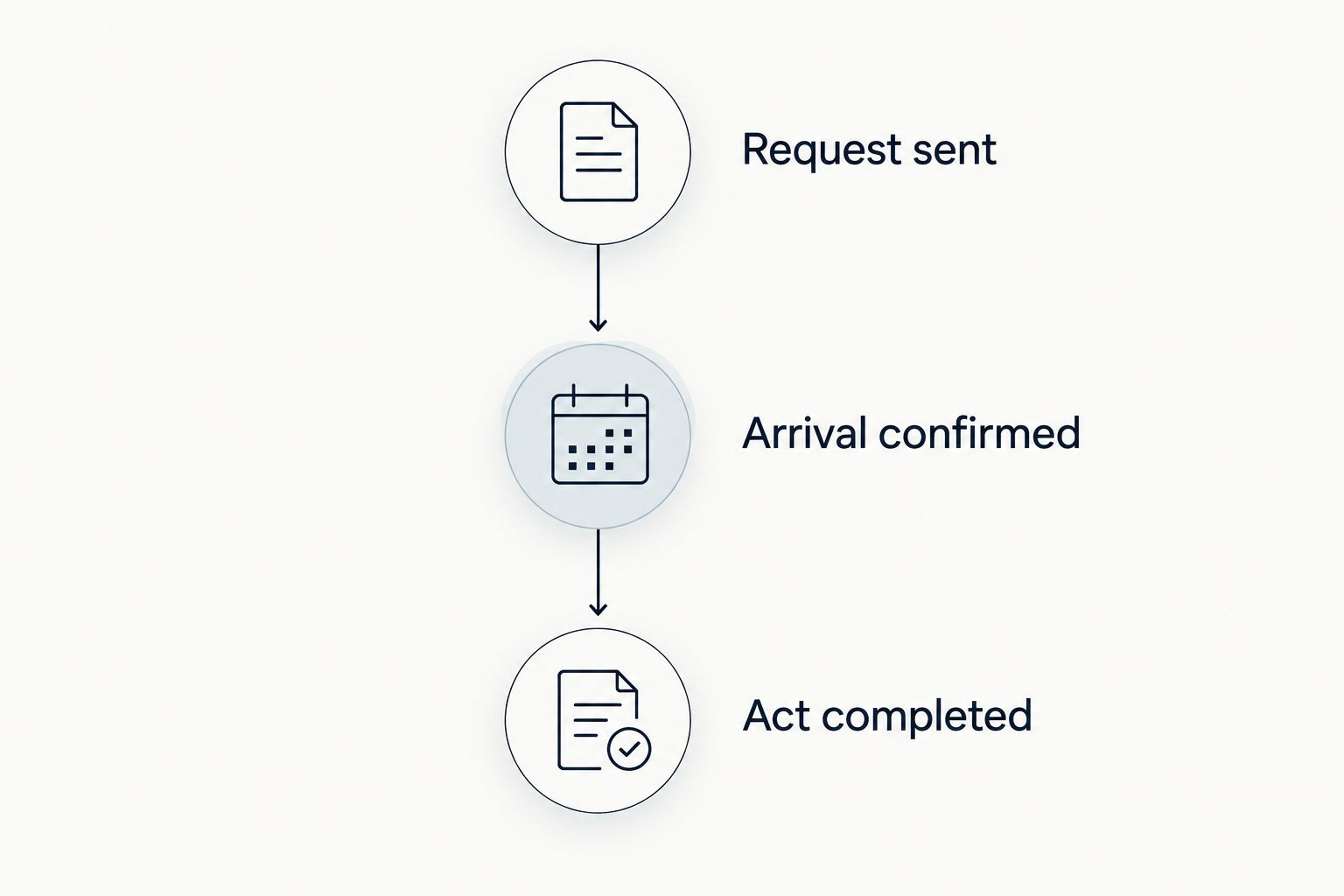
Use 3 checkpoints in your booking record: request submitted, arrival confirmed, and act completed. These are tracking steps, not promised service durations. A provider that responds promptly but leaves arrival unresolved has not yet solved your deadline.
Mobile notary options at a glance
This 2026 comparison ranks operational fit rather than unsupported speed claims. The first option is the default for a straightforward appointment; the others address requirements that can make a generic booking unsuitable.
| Rank and option | Best for | Standout advantage | Key limitation | Turnaround evidence to request |
|---|---|---|---|---|
| 1. Confirmed direct mobile appointment | Straightforward notarization with a firm deadline | Direct confirmation with the attending notary | You handle document and access coordination | Arrival window and confirmation of the requested act |
| 2. Credential-checked marketplace | Consumers and businesses arranging mobile services | A marketplace route to mobile professionals | A service request is not an arrival commitment | Assignment status and appointment confirmation |
| 3. Closing-package signing specialist | Real-estate document packages | Task-specific signing coordination | Closing-team requirements govern acceptance | Appointment, package instructions, and return deadline |
| 4. Facility-approved mobile notary | Hospitals and other restricted-access locations | Access requirements addressed before travel | Entry and signer participation remain separate checks | Facility permission and meeting arrangements |
| 5. Coordinated notary and apostille route | Documents intended for use abroad | Notarization and authentication planned separately | Notarization alone does not complete apostille processing | Separate completion points for each required stage |
1. Confirmed direct appointment: best for a firm local deadline
A direct mobile appointment means arranging the visit with the notary who will attend. For a straightforward document, this gives you a direct conversation about the location, requested act, identification, and arrival window.
The useful distinction is confirmed, not merely direct. A direct contact who cannot commit to an arrival window is less useful for deadline planning than another booking route with a confirmed appointment.
Confirmed direct appointment pros:
- You can clarify the document requirements with the attending notary.
- You can resolve parking and entry instructions before travel.
- You can distinguish the arrival window from the expected completion point.
Confirmed direct appointment cons:
- You are responsible for coordinating signers and document instructions.
- A single professional's schedule limits your appointment choices.
- Specialized packages can require coordination beyond an ordinary notarization.
Best for: A ready document, a reachable location, and a signer whose requirements are understood.
Ask whether the appointment confirmation covers the actual act you need. An acknowledgment and a jurat are different notarial acts; do not substitute one simply because it is easier to arrange. If the certificate or instructions are unclear, ask the document preparer or receiving party to clarify them.
Verdict: Buy the appointment only after the arrival window and document scope are confirmed.
2. Credential-checked marketplace: best for mobile-service requests
A marketplace connects a customer request with professionals rather than requiring the customer to start with an individual notary. Fieldflowlab's mobile notary services sit within an on-demand marketplace serving U.S. consumers and businesses.
Fieldflowlab also connects customers with professionals for apostille services, specimen collection, and identity-related services. That describes the marketplace's scope; it does not establish that one professional can perform every requested service or that separate tasks share a completion deadline.
Credential-checked marketplace pros:
- You have a marketplace route for requesting mobile services.
- You can describe the location and task before arranging the visit.
- Credential checking provides a distinct screening step when explicitly included.
Credential-checked marketplace cons:
- Sending a request does not establish an arrival window.
- Credential checks do not establish acceptance of a particular document.
- Multiple service types can involve separate professionals and requirements.
Best for: Consumers and businesses seeking mobile professionals through a marketplace.
For a 2026 business request, provide the ZIP code, required act, signer count, document type, and completion deadline together. Ask for the attending professional and appointment details before treating the request as scheduled. Keep credential screening, notarial authority, and document acceptance as separate checks.
Verdict: Buy after assignment and appointment confirmation; hold an unconfirmed request.
3. Closing-package specialist: best for real-estate signings
A closing-package signing specialist coordinates a document-signing appointment around the instructions supplied by the closing team. Some package documents require notarization; others require signatures without a notarial act.
The appointment is only part of the workflow. The title company, lender, attorney, or other responsible party can have package handling and return instructions that affect when the assignment is considered complete.
Closing-package specialist pros:
- Package instructions become part of appointment planning.
- You can coordinate signer attendance around the closing requirements.
- You can establish document return obligations before the visit.
Closing-package specialist cons:
- A completed signing does not establish that every closing condition is satisfied.
- Revised documents can change the appointment requirements.
- The closing team's acceptance criteria take priority over generic booking descriptions.
Best for: Real-estate packages with instructions from an identified closing team.
Confirm who supplies the final documents, who answers document questions, and where the signed package must go. Do not ask the notary to explain legal consequences outside the notary's role. Record the signing deadline separately from any scan or delivery deadline.
Verdict: Buy when the closing team accepts the professional and confirms package instructions.
4. Facility-approved notary: best for restricted-access visits
For a hospital or another controlled-access location, a useful appointment starts with access permission. A notary's willingness to travel does not establish permission to enter a particular room or meet the signer.
Facility approval addresses location access, not whether the notarial act can proceed. The notary must still satisfy the applicable requirements for identification, participation, and the requested act.
Facility-approved notary pros:
- Entry arrangements are checked before travel.
- A facility contact can clarify the meeting location.
- Access planning reduces uncertainty around the appointment itself.
Facility-approved notary cons:
- Facility permission does not establish signer readiness.
- Room changes and visitor restrictions can affect access.
- An urgent request does not override state notarial requirements.
Best for: Signers in locations where entry requires permission or coordination.
Name a facility contact and confirm the permitted meeting arrangement. Tell the notary about relevant participation or communication concerns before the visit rather than at the door. Do not describe a notarization as guaranteed merely because travel has been arranged.
Verdict: Hold until access and signer requirements are addressed; then buy the confirmed visit.
5. Coordinated apostille route: best for international documents
A notary-and-apostille workflow addresses separate tasks. Depending on the document and destination requirements, notarization can precede authentication, but not every document follows the same route.
An apostille is issued by a competent authority, not by a notary simply performing a notarial act. The Hague Apostille Convention concerns authentication of public documents for use between participating jurisdictions; it does not make notarization and apostille issuance interchangeable.
Coordinated apostille route pros:
- You can identify the destination requirements before notarization.
- You can separate the notary appointment from authority processing.
- You can define document submission and return responsibilities.
Coordinated apostille route cons:
- A quick notarization does not establish a quick apostille completion.
- Document type and issuing jurisdiction affect the required route.
- The receiving party can impose requirements beyond notarization.
Best for: Documents intended for use abroad when authentication requirements have been confirmed.
Fieldflowlab connects customers with mobile notary and apostille professionals. For either service, identify the issuing jurisdiction, destination country, document type, and receiving party's instructions before arranging work. Confirm whether an original, certified copy, translation, or another document form is required with the appropriate authority or recipient.
Verdict: Hold until the authentication route is confirmed; buy a coordinated request with separate completion points.
How this ranking works
The ranking prioritizes a confirmed appointment for a straightforward task, then routes with additional coordination requirements. Each option has a distinct use case; no position represents a measured national speed advantage.
For your own 2026 comparison, record 2 timestamps: when you submit a complete request and when the required act is completed. Keep any reply or assignment timestamp separately. Otherwise, a quick acknowledgment can look like a quick service even when the appointment remains unresolved.
Compare equivalent tasks. A single notarization, a closing package, and an international authentication workflow have different completion scopes. Ranking them by one reply-time measure obscures the work you actually need finished.
Build a request that can be scheduled
Use these steps to make the appointment requirement explicit:
- Request sent: Include the ZIP code, exact location, document type, required act, signer count, and deadline.
- Arrival confirmed: Obtain the appointment window and resolve identification, witness, and access questions.
- Act completed: Record completion of the notarization separately from document return or authentication work.
The sequence keeps request handling separate from appointment delivery. Do not close the task in your records merely because someone replied or accepted the request.
Which mobile notary option should you choose?
Choose a confirmed direct appointment for a straightforward document and firm local deadline. Choose a marketplace when you want a route to mobile professionals; choose a specialist when closing, facility, or authentication requirements govern the task.
Before committing, ask: What is confirmed, what remains unresolved, and what counts as completed? Those answers are more useful than a speed label. A 2026 turnaround comparison should end with an actionable appointment—not a provider name unsupported by an arrival commitment.
FAQ
What's the best way to compare mobile notary services ranked by turnaround time?
Compare confirmed arrival windows and completion scope for the same task. Track when a complete request is submitted and when the required act is finished; keep reply times separate.
Is a direct mobile notary faster than a marketplace?
The booking route alone does not establish which appointment finishes sooner. Compare the confirmed appointment, document requirements, and location access rather than assuming a direct contact or marketplace is faster.
Does Fieldflowlab provide a route to mobile notary professionals?
Fieldflowlab connects U.S. consumers and businesses with credential-checked mobile professionals, including mobile notaries. Confirm the requested act, attending professional, and appointment details for your specific request.
Can a mobile notary come to a hospital?
A hospital visit requires permission under the facility's access rules and a notary willing to attend. Facility access does not replace identification, participation, or other applicable notarial requirements.
Is a real-estate signing finished when the notary leaves?
The notarial acts can be complete while package return or other closing requirements remain outstanding. Follow the closing team's instructions and track signing and return obligations separately.
Does notarization include an apostille?
Notarization does not itself issue an apostille. Apostille processing is a separate authentication step handled through the relevant competent authority when applicable.
What should I send before booking a mobile notary?
Send the ZIP code, exact location, document type, required notarial act, signer count, and deadline. Clarify identification, witnesses, access restrictions, and any return instructions before confirming the visit.
One last thing
Ask the receiving party what it will accept before you book. A completed notarial act does not establish that the recipient will accept the document for its intended purpose. The fastest useful appointment is the one that completes the correct task.